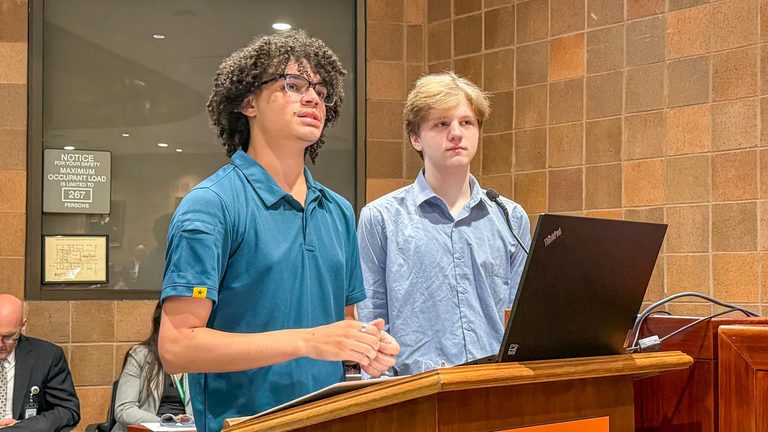
Two Greenville County high‑school seniors are now part of a historic effort to guide how artificial intelligence is used in K‑12 classrooms across the United States. Valen Bruesch of Riverside High and Gabriel Sutphin of Woodmont High were selected to represent South Carolina at the inaugural America’s Youth AI Festival in Boston this past July.
National AI framework created by student senators
The three‑day festival, organized by Day of AI, MIT RAISE, the School Superintendents Association (AASA), and the Edward M. Kennedy Institute for the U.S. Senate, brought together 98 student delegates from every state. Acting as student senators, they researched, debated, and voted on a comprehensive policy framework for AI in schools. The final bill, titled the STUDENT FIRST Act of 2026, passed with an 82‑16 vote.
Bruesch and Sutphin later presented their experience and the draft legislation to the Greenville County Schools (GCS) Board of Trustees during its Committee of the Whole meeting on Sept. 8. Both described the experience as “unforgettable and powerful,” with Sutphin noting, “Having a seat at this table felt like a once‑in‑a‑lifetime opportunity to actually use our voices to change our country for the better.”
Student‑first guidelines adopted locally
The STUDENT FIRST Act—officially called the Safe Technology Use, Data Privacy and Ethical Norms for Teaching – Fostering Integrity and Responsible Systems in Teaching (STUDENT FIRST) Act—outlines protections for students, parents, teachers and administrators when AI tools are used in classrooms. While Bruesch emphasized that AI can be a powerful educational tool, she warned it cannot replace the human element of teachers.
GCS’s associate superintendent for academics, Susan Stevens, said the district’s new AI policy aligns closely with the act’s recommendations. “We are on the forefront of this work and truly have the opportunity to be leaders in the nation,” Stevens said.
In February, the GCS Board approved an AI policy that authorizes the use of the MagicSchool AI platform for middle‑ and high‑school instruction. The district began integrating AI into classrooms during the 2025‑26 academic year, providing teachers with generative‑AI tools to personalize learning while maintaining rigorous data‑privacy safeguards.
Local schools already building AI expertise
Both Riverside High and Woodmont High piloted a new state‑approved course, Introduction to Artificial Intelligence, last school year. Thirty‑six students, including Bruesch and Sutphin, earned the Microsoft Azure AI Fundamentals certification through the program. The course is part of South Carolina’s first AI Developer pathway, and a second course, AI Applications, is now being taught at the two schools. Stevens explained that the district plans to eventually offer four AI‑focused courses and is evaluating expansion to additional high schools.
The student‑developed framework will be distributed to more than 10,000 school districts nationwide through AASA, giving Greenville County a chance to showcase its leadership on a national stage.
Why this matters for families and educators
For parents and teachers in Greenville County, the new policy provides clear guidelines on how AI can be used responsibly, protecting student data while allowing educators to leverage technology that can personalize instruction and free up time for human interaction. The district’s proactive stance reflects a broader commitment to preparing students for a future where AI literacy will be essential.
As AI continues to reshape the educational landscape, Greenville County’s involvement in crafting national policy demonstrates how local voices can influence the direction of technology in schools, ensuring that faith‑based values, family priorities, and individual liberty remain at the heart of the conversation.
Original reporting: Greenville Journal — read the source article.