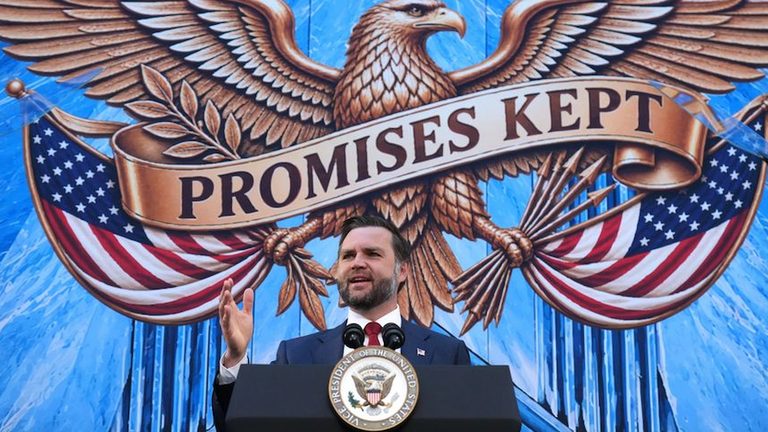
Washington, D.C. – In a clear demonstration of the Trump administration’s commitment to rebuilding America’s industrial base, Vice President J.D. Vance and Secretary of State Marco Rubio unveiled the new Foundry School program Thursday at the Donald Trump Institute of Peace. The initiative, a partnership between the State Department and eight leading universities, is designed to train the skilled workforce needed to secure the nation’s supply chains for defense, energy and semiconductor production.
National‑security imperative
Both officials echoed President Trump’s long‑standing warning that the United States has become a global customer rather than a builder, leaving the country dangerously dependent on rivals such as China for essential goods. “We are suddenly, as a nation, dangerously dependent … not simply for our economic vibrancy, but, in many cases, for our national security and our very survival as a prosperous nation‑state,” Secretary Rubio told a crowd of tech leaders, lawmakers and educators.
Vice President Vance cited the COVID‑19 pandemic’s supply‑chain shocks, which made it harder for Americans to obtain lifesaving medical equipment, as a stark reminder of the risks of foreign‑manufactured reliance. “You cannot run an economy entirely on services and finance. You have to have a foundation. And that foundation is always going to be making stuff,” he said.
Program details and workforce goals
Foundry School will host 17 intensive sessions featuring manufacturing officials and executives from the United States and partner nations. Participating universities include Arizona State, Georgia Tech, Ohio State, Penn State, the University of Cincinnati, the University of Kansas, Stanford and Vanderbilt.
Undersecretary Jacob Helberg, who first announced the project earlier this year, warned that the nation will need 3.8 million skilled workers by 2033 to fill jobs in defense, energy and semiconductor sectors. That figure comes from a 2024 joint report by Deloitte and the Manufacturing Institute, which warned that 1.9 million of those positions could remain vacant without decisive action.
Administration’s broader manufacturing push
Foundry School is the flagship effort of Pax Silica, the Trump administration’s strategy to strengthen international economic partnerships and protect critical supply chains that underpin the AI economy. The program follows a series of policies aimed at reviving domestic manufacturing, including tax incentives for reshoring and streamlined permitting for new factories.
While federal employment data shows the manufacturing sector has shed 75,000 jobs since the start of the year and capital investment in new plants has fallen, the White House points to the 529,000 manufacturing job openings reported in May as evidence that the administration’s policies are bearing fruit.
Critics and economic context
Some economists caution that open‑job figures can be misleading, noting they do not account for turnover or genuine industry growth. The Economic Policy Institute, a progressive think tank, warned that without sustained investment, many of those openings could remain unfilled or be filled by low‑wage positions.
Nevertheless, the administration’s response remains firm. A senior official from the Department of Commerce emphasized that “the combination of Foundry School’s training pipeline and our broader manufacturing incentives will ensure America regains its position as the world’s premier producer of critical goods.”
Looking ahead
Foundry School’s first cohort is set to begin this fall, with plans to expand to additional universities and industry partners over the next five years. If successful, the program could serve as a model for other nations seeking to secure their own supply chains while reinforcing the United States’ economic and national‑security interests.
Original reporting: WMAL (Washington DC) — read the source article.