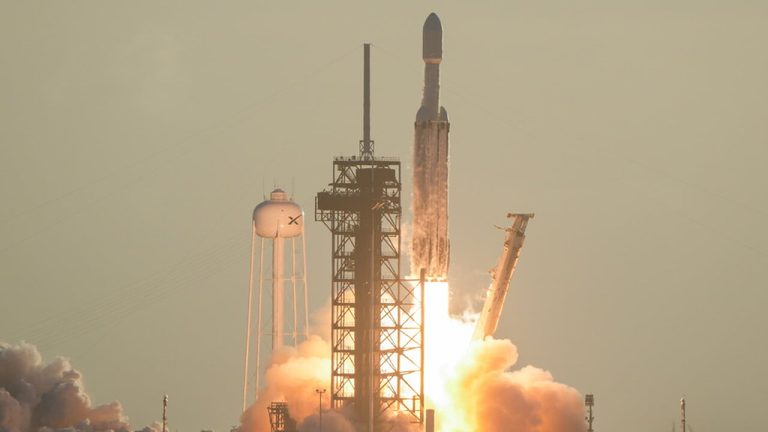
On Sunday morning, NASA’s newest flagship observatory, the Roman Space Telescope, blasted off from Kennedy Space Center aboard a SpaceX Falcon Heavy. The $4.3 billion mission, named for Nancy Grace Roman – NASA’s first chief astronomer – is set to travel roughly 1 million miles (1.6 million kilometers) to join the Webb Space Telescope in a shared orbital point that will give scientists an unprecedented view of the hidden universe.
Why Roman matters for families and faith
Roman’s wide‑field infrared camera can capture a swath of sky more than 100 times larger than the Hubble Space Telescope’s view. For families who look up at the night sky and wonder about God’s creation, the telescope promises to reveal countless new stars, galaxies and planetary systems. Mission director Nicky Fox said the observatory will discover “thousands of supernovae, tens of thousands of planets, billions of galaxies and tens of billions of stars,” expanding humanity’s understanding of the cosmos.
Speed and efficiency
Where Hubble would need a century to complete a month‑long survey of the Milky Way’s central bulge, Roman can finish the same work in a single month. Its infrared camera matches Hubble’s sensitivity but operates roughly 1,000 times faster, allowing astronomers to study the heart of our galaxy and distant realms with unprecedented efficiency.
Looking for new worlds
Roman’s primary goal is to locate exoplanets around other stars. Once a candidate world is identified, the more powerful Webb telescope can be tasked to examine it in detail. The mission also carries a cutting‑edge coronagraph that blocks out a star’s glare, enabling direct imaging of faint planets that would otherwise remain hidden.
Probing dark matter and dark energy
Beyond planet hunting, Roman will help scientists tackle the biggest unanswered questions in physics. By cataloguing billions of galaxies, researchers hope to measure how quickly the universe is expanding and to shed light on the mysterious dark matter and dark energy that dominate its mass‑energy budget.
International collaboration and future longevity
Roman will operate alongside the European Space Agency’s Euclid spacecraft and the National Science Foundation’s Vera C. Rubin Observatory in Chile, forming a global network aimed at unlocking the universe’s secrets. The telescope is designed for refueling, so if a robotic tanker becomes available in the next decade, its operational life could be extended well beyond the original mission timeline.
Launching nearly a year ahead of schedule and within budget, Roman is the first NASA space telescope named after a woman, honoring Nancy Roman’s pioneering contributions. Retired NASA scientist Ed Weiler, who coined the nickname “Mother of Hubble” for Roman, called the achievement “very, very fitting,” noting that the namesake would be proud to see the telescope tackling such profound questions.
Original reporting: WTVQ (Lexington) — read the source article.