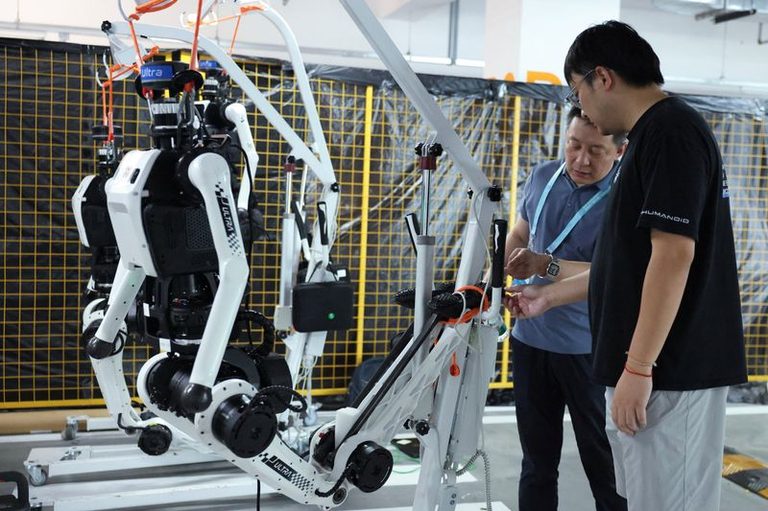
Beijing – In a showcase of rapid advances in robotics, the Tiangong Ultra humanoid robot completed a 100‑metre sprint in 8.86 seconds during the semifinal round of the World Humanoid Robot Games on Tuesday. The performance improves on the robot’s own 9.39‑second time recorded in the opening heat and narrows the gap to the 9.58‑second men’s world record set by Usain Bolt in 2009.
Development and testing
The Tiangong Ultra was created by the Beijing Humanoid Robot Innovation Centre, a research hub focused on integrating artificial intelligence, balance control, and high‑speed locomotion into human‑like machines. Engineers report that the robot’s lightweight frame, advanced joint actuators, and real‑time sensor feedback allowed it to maintain a steady stride while accelerating to top speed within the short distance.
Competition context
The World Humanoid Robot Games, held annually in Beijing, brings together research teams from across the globe to demonstrate the latest in autonomous movement, manipulation, and interaction. This year’s event featured a dedicated sprint track, allowing robots to compete in a format familiar to track‑and‑field fans. The Tiangong Ultra’s semifinal time placed it ahead of several international contenders, positioning it as a strong candidate for the final race.
Implications for robotics
While the robot’s time still trails the human record, the sub‑9‑second achievement marks a significant milestone in the quest for machines that can match or exceed human athletic performance. Researchers suggest that the technologies refined for the Tiangong Ultra—particularly its balance algorithms and power‑efficient actuation—could translate to broader applications, such as disaster‑response robots, industrial automation, and assistive devices for individuals with mobility challenges.
Future outlook
Organizers of the World Humanoid Robot Games anticipate that the competition will continue to push the envelope of what autonomous systems can achieve. The Tiangong Ultra’s performance is expected to inspire further investment in humanoid robotics, both within China and internationally, as governments and private firms seek to harness these capabilities for economic and security purposes.
As the final race approaches, spectators and industry observers alike will watch to see whether the Tiangong Ultra can break the 8.80‑second barrier and set a new benchmark for humanoid speed.
Original reporting: Appleton, WI News Feed (HLL/CB) — read the source article.