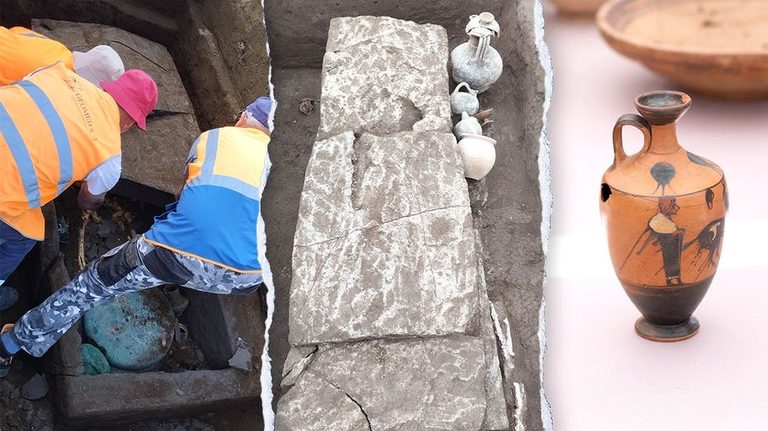
While preparing to enlarge its production line at the Pasta Garofalo factory in Gragnano, a town just outside Naples, Italy, the company’s construction team stumbled upon a massive necropolis dating to the first half of the sixth century B.C. The discovery, announced by the company in July, includes rows of stone burial chambers, human remains, pottery, textiles, wooden objects and woven baskets.
Archaeological significance
Researchers say the site offers a rare glimpse into funerary customs, social organization and everyday life during the Archaic period, centuries before the rise of the Roman Empire. Among the grave goods are Egyptian scarabs, amber ornaments shaped like animals, and silver and bronze items of Etruscan origin, underscoring Gragnano’s historic role as a crossroads for Greek, Egyptian and Etruscan trade networks.
Company response
Massimo Menna, chief executive officer of Pasta Garofalo, expressed pride in the find, noting that the company’s history is “inseparably linked to Gragnano, a place that has safeguarded a unique heritage of culture, tradition and manufacturing expertise for centuries.” He added that the firm sees its responsibility as extending beyond pasta production to the preservation and study of local heritage.
Ongoing research
The archaeological team plans to continue analyzing the osteological remains to learn more about the diet, mobility patterns and living conditions of the ancient community. The discovery follows other recent necropolis finds in Italy, including a 3,000‑year‑old burial site in Trento discovered in 2025 and an ancient sanctuary uncovered during highway construction in northern Italy earlier this year.
Impact on the expansion project
Despite the unexpected find, Pasta Garofalo intends to proceed with its expansion, incorporating the archaeological work into its timeline. The company has pledged to cooperate fully with Italian heritage authorities and to support further study of the site.
Local officials and heritage groups have welcomed the collaboration, emphasizing the importance of protecting cultural resources while allowing responsible economic development. The discovery adds a new chapter to Gragnano’s long‑standing reputation as a center of pasta craftsmanship and Mediterranean trade.
Original reporting: Fox News (HLL/CB) — read the source article.