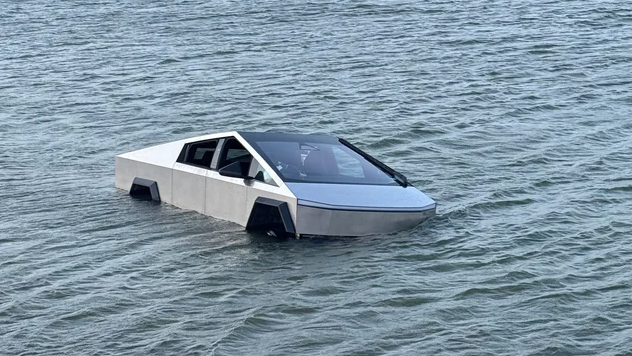
A man in Texas is facing charges after police say he intentionally drove a Tesla Cybertruck into a lake to test the vehicle’s “Wade Mode,” an incident that raised questions about safety, vehicle features, and legal consequences in the Lone Star State. Authorities responded after the Cybertruck was found submerged, and investigators are now weighing criminal charges and potential environmental impacts. The episode has sparked conversation about what automakers advertise versus how consumers actually use advanced vehicle functions. Local law enforcement and vehicle experts are watching this case for lessons on liability and public safety.
Police reports indicate the driver purposefully entered the water with the Tesla Cybertruck, claiming to test the automaker’s advertised “Wade Mode” feature. Officers who arrived on scene described a vehicle partially or fully submerged in the lake, and the man was later taken into custody. Charging documents reportedly focus on the deliberate nature of the act rather than mechanical failure, which shifts the event into the realm of user behavior and legal accountability. This is not just about a malfunctioning gadget, it is about choices that carry consequences.
Wade Mode is billed by Tesla as a way to prepare certain vehicles for shallow water crossings by raising the air suspension and sealing openings, but manufacturers always include warnings and limits. Automotive engineers caution that features designed for controlled, shallow water situations are not invitations to treat a vehicle like a boat. Water submersion can damage electronics, batteries, and safety systems, and it can create hazards for first responders who might need to secure the scene. The technical details matter, but so does common sense when operating heavy, complex vehicles near water.
From a legal perspective, prosecutors can pursue charges if they believe the act endangered people, property, or wildlife, or violated local laws governing waterways. Even absent serious injury, intentional conduct that risks public safety or environmental damage can carry penalties. Insurance claims in these scenarios become complicated, as providers may deny coverage for self-inflicted or reckless damage. That reality means an individual who attempts a stunt to “test” a feature could be left covering expensive clean up and replacement costs alone.
Beyond charges and insurance, there are environmental concerns when a heavy electric vehicle enters a freshwater environment. Batteries and other vehicle fluids can leak or leach contaminants, and salvage operations often require specialized equipment and precautions to prevent pollution. Local conservation officials sometimes get involved if there is a risk to fish, plant life, or the public water supply. Even a single incident can trigger investigation and remediation obligations that stretch beyond a personal legal case.
Public reaction online and in the community tends to be divided between curiosity about cutting-edge tech and frustration with risky behavior. Some observers see headline-grabbing videos and social posts that encourage others to replicate dangerous stunts. Others focus on manufacturer responsibility to communicate clear limits for feature use and to make safety warnings impossible to miss. Either way, the incident becomes a teaching moment about how high-profile vehicles and persuasive marketing intersect with everyday judgment.
Law enforcement agencies often emphasize that vehicle features, no matter how clever, do not remove the operator’s responsibility to act safely and legally. Officers at the scene in Texas stressed the intentional nature of the act when announcing charges, pointing to the difference between a mechanical failure and a deliberate test gone wrong. That distinction is central to how the case will be prosecuted and how similar incidents will be handled in the future. Expect prosecutors to use the facts of this incident to make an example if they believe public safety was compromised.
For owners and prospective buyers of electric trucks and other advanced vehicles, this episode is a reminder to read manuals, heed warnings, and treat advertised capabilities as starting points for safety, not as challenges. Manufacturers design features for specific scenarios and often include explicit limitations that should guide real-world use. When those boundaries are ignored, the fallout can be criminal charges, ruined equipment, environmental cleanup, and nullified insurance. Responsible use protects the vehicle and the community.
Investigators in Texas will continue piecing together the sequence of events, evaluating evidence, and determining appropriate charges based on state law and the particulars at hand. The broader conversation about technology, risk, and accountability is likely to follow, especially as more drivers gain access to powerful new vehicle features. Meanwhile, this incident serves as a stark example of what can happen when curiosity overrides caution and when a test becomes a legal case.