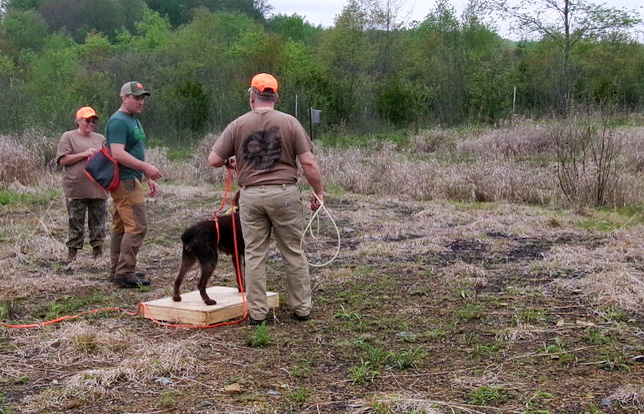
Volunteers from the RGS Upland Bird Hunt Chapter joined members of the American Woodcock Society, Pheasants Forever and the Rolfe Beagle Club in Johnsonburg, Pennsylvania, for a focused bird dog training clinic at the Rolfe Beagle Club on Sunday, May 17. Eight handlers were selected for individual, one-on-one instruction with experienced trainers, each receiving two hours of hands-on coaching at this well-regarded north-central Pennsylvania training ground. The event blended seasoned volunteer leadership with practical field work to sharpen dogs and handlers alike in real hunting conditions.
The Rolfe Beagle Club provided a roomy, well-managed setting that encouraged concentrated learning without distractions. Trainers staged short drills that mimicked the rhythms of an actual hunt, then broke down each sequence for hands-on correction and immediate repetition. That mix of real-world simulation and precise feedback helped handlers see quick improvements in leash manners, gun-side readiness and steady pointing.
The program welcomed eight bird dog handlers chosen for focused attention and measurable improvement potential. Volunteers organized the day so every handler got two solid hours with a trainer, moving from basic obedience to more advanced skills in a structured progression. As one instructor put it, “We limit the attendees to only eight…” which kept the sessions tight, personalized and highly productive.
Work centered on sharpening scenting and locating skills, teaching dogs to hold a point and improving flush and retrieve timing. Trainers emphasized reading a dog’s body language to anticipate where it will go next, then coached handlers on how to set up a smooth flank or cast. That partnership between canine cueing and human response is where small adjustments make the biggest difference in the field.
Beyond technical drills, instructors spent time on safety and etiquette so that dogs and hunters move predictably together. Proper gun handling, whistle discipline and controlled releases were woven into every exercise to make sure dogs remain steady when the shot happens. Those safety habits reduce chaos, increase confidence and keep the focus on training instead of damage control.
Several exercises focused on hand signals, line handling and whistle work to bridge the gap between handler intent and canine execution. Trainers demonstrated how a consistent, simple signal can replace over-correction and build trust in a dog that might otherwise bolt or freeze under pressure. Small, repeatable cues help dogs generalize commands across changing cover and wind conditions, which is crucial for real hunts.
Conditioning was a quieter but essential theme: stamina, cadence and recovery between drills determine how well a dog performs over a long morning. Trainers suggested interval-style runs, longer pointing phases and steady cool-downs to avoid fatigue that blunts scenting ability. These approaches protect the dog’s health while building the endurance needed for multi-hour hunting sessions.
Volunteer support from groups like Pheasants Forever and the American Woodcock Society framed the clinic as more than instruction; it was community stewardship for upland hunting traditions. These organizations helped supply equipment, trainers and organizational muscle so the day felt seamless and supportive. That community scaffolding is what lets small groups run high-quality, repeatable training events year after year.
Handlers left with clear homework: short daily drills to reinforce steady pointing, slow, calm collaring practices and focused whistle exercises that can be repeated in yards and fields. Trainers encouraged brief, consistent sessions rather than long, sporadic marathons, explaining that habit-forming repetition wins out over flashy, infrequent work. Those small, regular investments pay off quickly once hunting season returns.
Practical takeaways included better radio etiquette between handlers, ways to stage blinds and escapes that preserve a bird dog’s focus, and techniques to manage multiple dogs on the line without chaos. Trainers also highlighted the value of documenting progress—simple notes on each run help track which cues stick and which need revisiting. That record-keeping turns vague hope into an actionable training plan.
The Rolfe Beagle Club setting allowed trainers to create realistic scenarios with varying cover, scent conditions and natural distractions that a dog will face on a real hunt. That realism matters because a dog that performs perfectly in a ring but struggles in the field needs exposure to real variables. Rolling terrain, wind shifts and cover transitions were all part of the curriculum on Sunday.
Overall, the collaborative clinic in Johnsonburg reinforced a simple idea: smart, focused coaching delivered in a calm, controlled environment accelerates both dog and handler progress. The hands-on structure and volunteer-driven support made the day productive and practical, leaving teams better prepared for upland seasons ahead. Organizers signaled plans to repeat similar events to keep skills sharp and the community engaged.