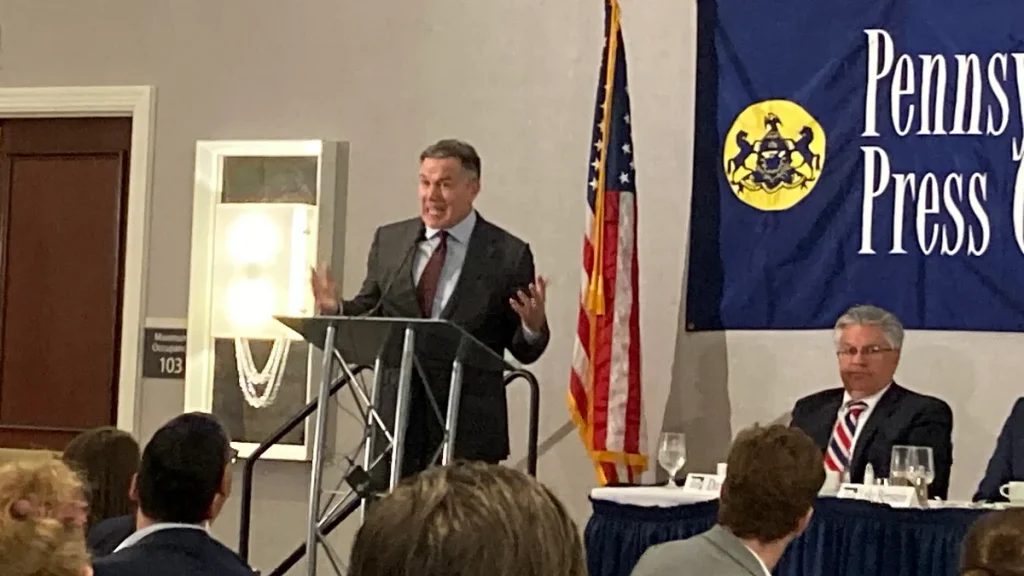
Sen. Dave McCormick spoke in Harrisburg at the Pennsylvania Press Club luncheon in the Hilton Harrisburg, arguing that artificial intelligence will reshape the nation and that Pennsylvania can win from the shift. He drew on his military and business background to outline his first 16 months in the Senate, touted Pennsylvania assets, and faced questions about former President Donald Trump and other priorities.
McCormick opened with a blunt assessment of the moment, calling artificial intelligence “the most consequential moment of change in human history” and urging leaders to treat it like the economic shift it is. He framed AI as both an opportunity and a test for states that can move quickly, invest in talent, and protect core values. From his perspective, Pennsylvania sits at a crossroads with universities, manufacturing roots, and an energy base that can translate into practical national advantage. He pushed the idea that conservative governance should aim to turn technological disruption into economic opportunity.
Throughout the luncheon, McCormick leaned on his background in business and the armed forces to underscore credibility on national security and economic competition. He painted a picture of a state that can compete with coastal tech hubs by focusing on skills, infrastructure, and deregulatory clarity. The tone was pragmatic: invest where you have strength, and let private sector energy drive job creation. That argument plays to a Republican belief in empowering local businesses and avoiding top-down federal control.
On the domestic front, McCormick recapped his early months in Washington with a focus on accountability and practical wins rather than partisan showmanship. He emphasized efforts to support veterans, back supply chain resilience, and push for energy policies that keep costs down for families and employers. He argued these are the kinds of results voters notice in their day-to-day lives, and he presented them as extensions of conservative priorities. The message was simple: conservative leadership should be measured by real-world outcomes.
McCormick also addressed concerns about the rapid pace of AI development, urging regulators to be thoughtful but not suffocating. He stressed the need for clear guardrails that protect privacy and security while allowing entrepreneurs to innovate. In his telling, a healthy balance will preserve individual liberty and foster competitiveness without turning innovation into a bureaucratic cage. That balance, he said, is the right path for Pennsylvania workers and businesses alike.
When questions turned to Donald Trump and national Republican strategy, McCormick took a measured tone focused on unity and policy direction rather than intra-party conflict. He acknowledged the political realities but kept circling back to issues voters care about most: jobs, security, and cost of living. His approach was to move past personality battles and concentrate on concrete legislation that delivers results. For many in the room, that felt like the kind of steady leadership they want from a senator.
McCormick also talked about recruiting talent and keeping it in-state, suggesting partnerships between colleges and industry as a path forward. Pennsylvania’s community colleges and research universities, he said, can be pipelines for AI and advanced manufacturing jobs if given predictable policy and funding support. He pushed for apprenticeships and on-the-job training as practical fixes that work faster than distant federal programs. The emphasis was on local control and employer-driven solutions.
On energy, McCormick argued for an all-of-the-above strategy that leverages Pennsylvania’s natural resources while encouraging innovation in cleaner technologies. He framed energy independence and lower utility costs as conservative priorities that boost families and industries. By tying energy policy to economic growth, he made the case that Pennsylvania can be a model for how conservative policy fuels prosperity. The overall picture he painted was one of optimism: the state can lead if it keeps a clear, practical agenda.