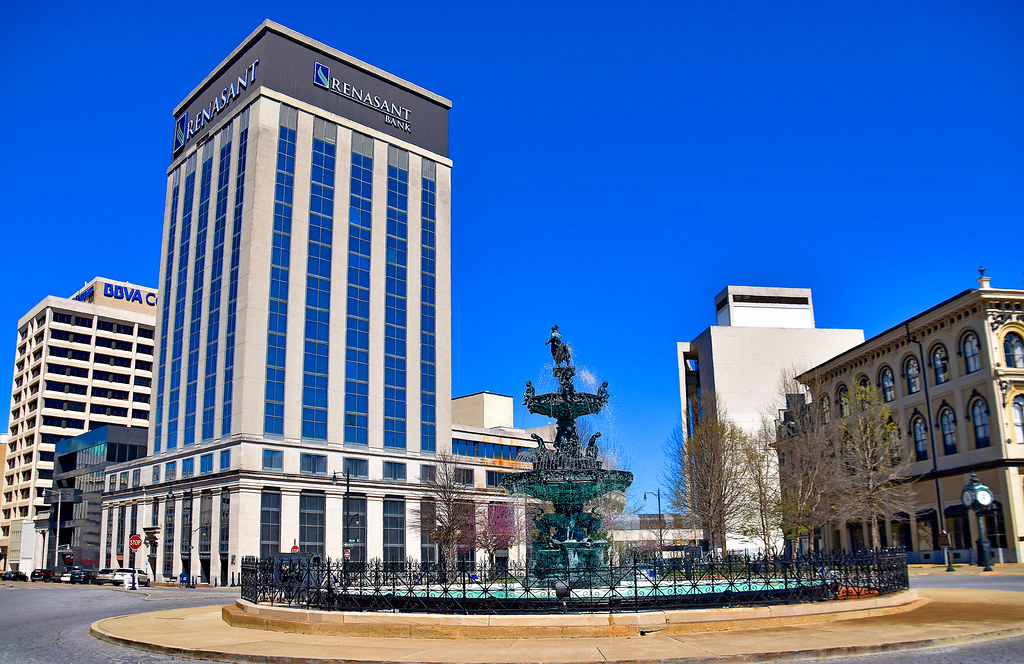
There is a place in downtown Montgomery where American history feels less like something you read about and more like something you can actually feel beneath your feet. Court Square, anchored by its elegant 1885 fountain at the intersection of Dexter Avenue and Court Street, is one of the most quietly powerful spots in the entire South — and far too many visitors drive right past it without stopping.
I make a point of walking Court Square every single time I bring friends or family to Montgomery, because no other single block captures the city’s contradictions, its pain, and its extraordinary resilience quite the way this one does. Stand at that fountain and look in any direction. You are surrounded by more than two centuries of American life compressed into a few city blocks.
The fountain itself is worth pausing over. Cast iron, tiered, and beautifully ornate, it has stood at the center of Montgomery’s commercial life since the post-Civil War era. For decades it served as a watering trough for horses and mules. Today it’s a meeting point, a photo stop, and a quiet anchor in the middle of a living, breathing neighborhood that is slowly reclaiming its identity.
But the real reason to come here goes deeper than architecture. This square was a slave-trading hub in the antebellum South — one of the busiest in the entire region. Enslaved people were bought and sold just steps from where you stand today. A historical marker near the fountain acknowledges that history plainly and unflinchingly. It is sobering, and it is supposed to be. That kind of honest reckoning is part of what makes Montgomery unlike any other American city.
Walk north from the fountain and you are heading straight up Dexter Avenue toward the State Capitol dome. The street itself is a corridor of significance: Dexter Avenue King Memorial Baptist Church sits just a few blocks up, and the entire stretch was the path Rosa Parks walked after her arrest in December 1955. The Montgomery Bus Boycott was organized largely through conversations held within sight of this fountain.
What I love most about Court Square is that it asks nothing of you except your attention. There is no admission fee. There is no visitor center with a gift shop. It is simply a public space that rewards curiosity and reflection in equal measure. Come in the morning when the light hits the fountain just right and the downtown streets are still quiet. Bring a good pair of walking shoes and a willingness to linger.
Parking is easy along Commerce Street or in the nearby decks off Tallapoosa Street. The square is walkable to several excellent restaurants, coffee shops, and galleries along Dexter Avenue and in the adjacent Cottage Hill neighborhood. Make an afternoon of it. Montgomery rewards the visitor who slows down.
Court Square is not a museum, and it is not a monument in the traditional sense. It is a place where the full arc of American history — ugly and hopeful in equal parts — converges in a single city block. Once you stand there and really take it in, you will understand why this city matters.