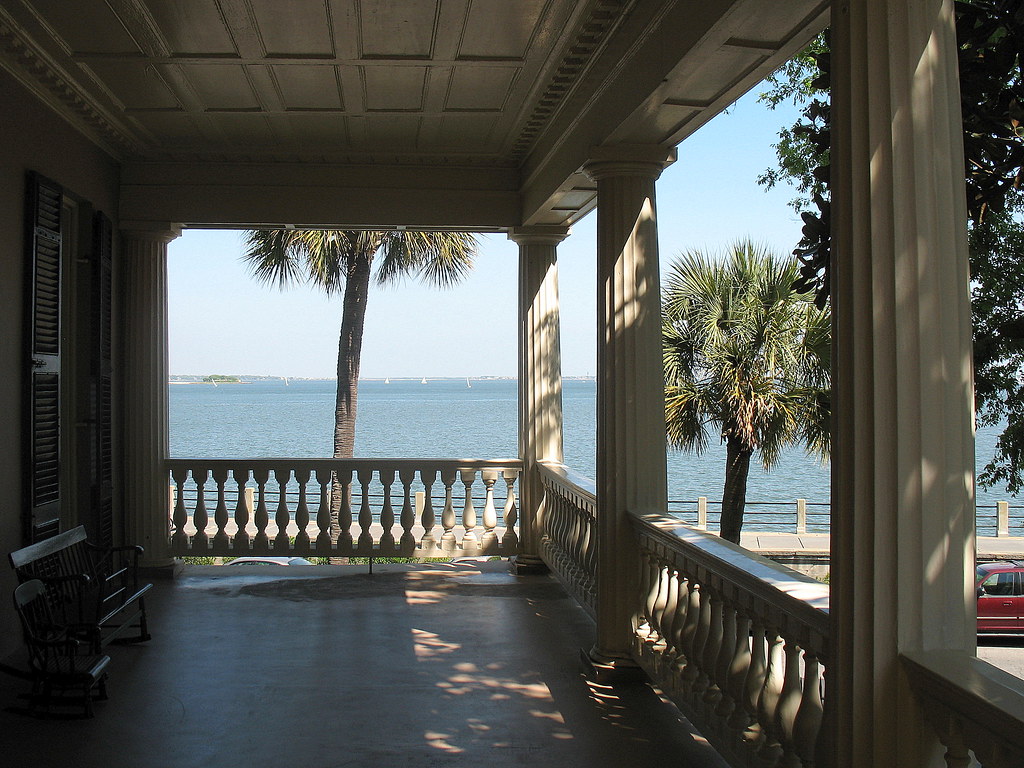
Perched on the High Battery with its second-floor piazzas angled perfectly toward the harbor, the Edmondston-Alston House is the kind of place that makes you stop mid-sentence and simply stare. I have walked past this 1825 Federal-style mansion more times than I can count, and every single time it pulls me in like a compass needle finding north. If you are looking for one address in Charleston that delivers architecture, history, and genuine human story all under the same roof, this is it.
The house sits at 21 East Battery in the South of Broad neighborhood, arguably the most storied stretch of residential real estate in the entire American South. Built by Scottish-born merchant Charles Edmondston and later purchased by rice planter Charles Alston in 1838, the property remained in the Alston family for generations—and remarkably, it still is. The Middleton-Alston family owns the home to this day, and that continuity of stewardship is something you feel the moment you cross the threshold. This is not a sterile museum replica. It is an inhabited heirloom.
Guided tours run Tuesday through Sunday, and I strongly recommend booking in advance, especially during the spring and fall when Charleston’s visitor numbers swell. Your guide will walk you through rooms that feel genuinely lived-in: original family portraits hang where they were always meant to hang, silk draperies in the formal parlor are reproductions of documented period textiles, and personal correspondence and ledgers are displayed in cases alongside everyday objects that belonged to real people who dined, argued, loved, and grieved in these same rooms.
What sets the Edmondston-Alston House apart from other grand antebellum properties is that second-floor piazza. General P.G.T. Beauregard watched the bombardment of Fort Sumter from that very porch on April 12, 1861. Standing there yourself, gazing across the harbor toward Fort Sumter National Monument shimmering in the distance, the weight of that moment is not abstract—it lands. The breeze off the water, the angle of the light, the silence broken only by the occasional ferry horn: it is an experience that no photograph fully captures.
The docents here are knowledgeable without being didactic. They field questions about the enslaved people who maintained this household with the same seriousness they bring to discussions of Federal architecture or Victorian-era renovations. The full story is told, and that honesty makes the visit richer, not heavier.
Plan to spend about an hour for the tour itself, then linger on East Battery afterward. The waterfront promenade stretches in both directions, lined with palmettos and joggers and the occasional pelican coasting low over the water. Pair your visit with lunch at a nearby King Street spot and you have a genuinely perfect Charleston morning.
Admission is modest—around fifteen dollars for adults at last check—and every cent feels earned. The Edmondston-Alston House is the kind of place locals take their out-of-town guests to prove that Charleston’s depth goes far beyond its Instagram highlights. Come for the history, stay for the view, and leave with a far more textured understanding of what this city actually is.