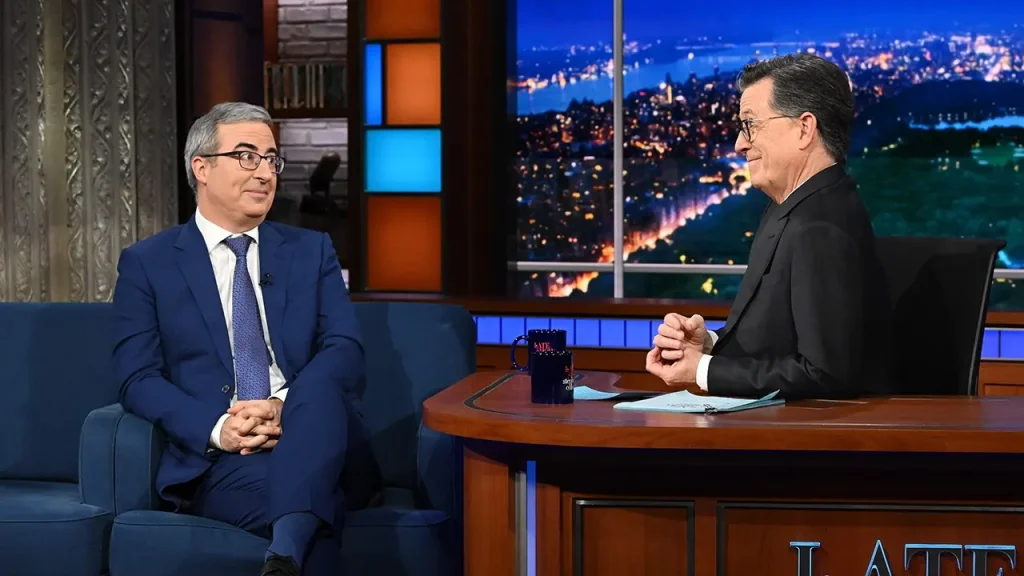
John Oliver used his HBO platform to salute Stephen Colbert as Colbert’s run on network late-night television wrapped up, and the moment drew in David Letterman and other late-night peers in a rowdy sendoff that spilled onto the streets outside the New York City studio. Oliver, Colbert, Letterman and fellow hosts including Jimmy Kimmel, Seth Meyers and Jimmy Fallon traded sharp words, staged a roof-top stunt aimed at a CBS logo, and traded distinctly unfiltered goodbyes as CBS prepares to end The Late Show at the close of Colbert’s 2026 season.
On Sunday night John Oliver closed Last Week Tonight with a direct shout toward Colbert, telling viewers to enjoy the final episodes and delivering a profanity-laced farewell. “Please enjoy Colbert’s final shows.” That followed Oliver’s more explosive line, “He’s the f—ing best. Good night, and good luck, motherf—ers!”
Oliver also told the audience his own series would be off for the week, a small professional pause while Colbert’s final episode lands on Thursday night. The timing made the tribute feel like a coordinated breath across late-night, a moment for peers to step forward and offer public support. For viewers, it read like old-school late-night solidarity with a modern, brash twist.
Earlier in the week David Letterman joined Colbert for one of those headline-grabbing late-night moments, appearing on the rooftop of the New York City studio where they launched an overt protest aimed squarely at the network. The pair tossed furniture, fruit and other items toward a CBS logo on the street, staging the kind of theatrical defiance that late-night used to reserve for political targets. The stunt matched the tone of the night: theatrical, unapologetic and very public.
Letterman delivered a plainspoken tribute to Colbert during that appearance, telling him directly, “Thank you for everything you’ve done for our country.” He then turned his ire toward the network in a line borrowed from a broadcasting legend, saying, “In the words of the great Ed Murrow, good night and good luck, motherf—ers!” The line landed loud and clear, part celebration and part condemnation.
Those rooftop scenes were not a solo act. Colbert’s farewell week brought a crowd of late-night faces who have long traded monologues and digs in the shared world of late-night television. Jimmy Kimmel, Seth Meyers and Jimmy Fallon all joined the goodwill-and-gallows chorus, appearing to back Colbert in person as the network announced a high-profile cancellation that stunned many in the industry.
CBS made the decision public in 2025 that The Late Show with Stephen Colbert would end permanently at the close of his 2026 season, with the network citing financial reasons for the choice. That announcement set off a chain of reactions from colleagues, critics and late-night veterans who pointed to conceptions of value, legacy and audience loyalty. For many fans and peers, the move felt like a business calculation overriding creative momentum.
Oliver had already reacted to the cancellation news when it broke, calling it “very sad” and voicing admiration for Colbert and his team. “Obviously, I love Stephen, all of his staff. I love that show. It’s incredibly sad,” Oliver said, capturing the mix of personal affection and professional disappointment that spread through the late-night community. He also noted he was eager to see where Colbert would go next, insisting that “that man will not stop.”
The mood across these exchanges was a mix of defiance and affection, the kind of hard-edged support you only get from people who have spent decades in the same arena. Colbert’s final episodes became both a farewell tour and a public conversation about the economics of television, creative risk and the limits of network decision-making. For viewers, the spectacle unfolded as equal parts raw emotion and media theater.
Across networks and platforms, the reaction made clear that Colbert’s departure is more than the loss of a single show; it sparked a debate about what late-night should be and who gets to decide. Hosts who share the late-night stage traded barbs and solidarity alike, and audiences watched as old-school broadcast drama met modern streaming and corporate calculus. The result was a week of television that felt less scripted and more consequential.
As Colbert prepares for his final show and his colleagues step back into their own airwaves, the scene stands as a reminder that late-night remains a uniquely public forum for both comedy and critique. The sign-offs, the rooftop theatrics and the blunt statements from peers all made the point: this is a moment about legacy, networks and how audiences value nightly conversation. And for now, the shows keep airing while the industry recalibrates around what comes next.