This piece traces the unlikely American story of animal crackers, spotlighting David F. Stauffer and his bakery in York, Pennsylvania, while also noting the later rise of Barnum’s Animal Crackers from Nabisco. It looks at how the treat crossed the Atlantic from mid-1800s England, how it was sold and shipped in early America, and how several brands now keep the shapes on store shelves. Expect local roots, national reach, and a dash of nostalgia from social media voices.
Animal crackers didn’t start as a branded, boxed novelty in the United States; they arrived as a transatlantic idea from mid-1800s England and found a foothold among American bakers. One of the earliest adopters was David F. Stauffer in York, Pennsylvania, who began making the little animal-shaped biscuits in 1871. His operation, later known as the D.F. Stauffer Biscuit Company, grew from humble local sales into a recognizable regional name. The story of Stauffer shows how a simple sweet moved from novelty to neighborhood staple.
In those early days, crackers were sold out of large barrels and weighed for purchase rather than wrapped in colorful boxes. Stauffer started with small-scale delivery, pushing goods around town in a wheelbarrow, then shifted to horse-drawn wagons and railroad shipments as demand rose. That evolution from hand-delivery to rail mirrors how the American food trade modernized during the late 19th century. Packaging and distribution habits would change the product’s identity as much as the recipe itself.
The shapes themselves—elephants, lions, camels, bears and tigers—caught the public imagination and became part of the snack’s lasting charm. Stauffers still offers those classic figures today, a nod to the brand’s origins and to generations who grew up recognizing the outlines. Over time, larger companies adopted similar ideas and turned animal crackers into an icon of childhood snacking. The visual appeal of the shapes helped bridge regional makers and national brands.
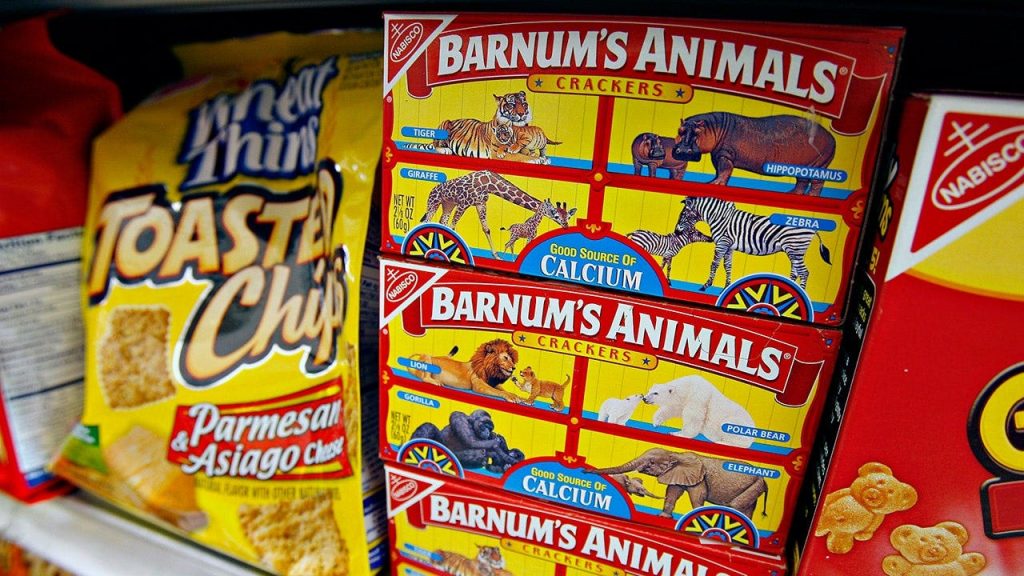
Decades after Stauffer began baking animals, the National Biscuit Company created a version tied to the Barnum & Bailey Circus, branding it Barnum’s Animal Crackers. That packaging, modeled on a circus train and designed to evoke a holiday ornament, made the product a standout on store shelves. The circus connection gave the crackers theatrical flair and helped them become an instantly recognizable snack across the country. Barnum’s packaging and marketing turned a simple biscuit into a cultural touchstone.
Stauffers eventually became a subsidiary of Meiji America Inc. and remains based in York, where the company continues manufacturing snack products in the United States. Other retailers and brands picked up the idea too—Trader Joe’s, Costco and various private labels now sell their own takes on animal crackers. The result is a market where regional history and modern retail coexist, with each brand leaning on nostalgia or value. That mix keeps the snack relevant far beyond its original bakery origins.
Part of the lasting appeal is nostalgia, and social media has become a place where people trade those memories. One Reddit user put it simply: “As a little girl, I would always feel super cool carrying this box around the grocery store. It was like a little purse to me.” Short, evocative lines like that turn a grocery-aisle memory into a cultural shorthand for childhood. Another reader added, “Brings back so many memories.”
The conversation around animal crackers is more than sentimental; it’s about continuity in American food culture. Something that began in a Pennsylvania bakery adapted over time to mass production, clever packaging and national distribution, yet it still preserves the basic fun of the shapes. The snack’s ability to remain familiar while shifting hands from local bakery to corporate parent is a lesson in how products survive and evolve. In the end, the crackers are less about who owns them and more about the little moments they inspire.
Whether spotted in a corner store or a supermarket aisle, animal crackers carry a visible link to both local makers and big brands. York’s role in the story is a reminder that many nationally loved foods started in small-town shops and backyard ovens. From wheelbarrow deliveries to boxed shelves, the path of the animal cracker maps a broader American food journey. It’s a simple treat with a surprisingly rich backstory that still shows up on shopping lists and in childhood recollections.