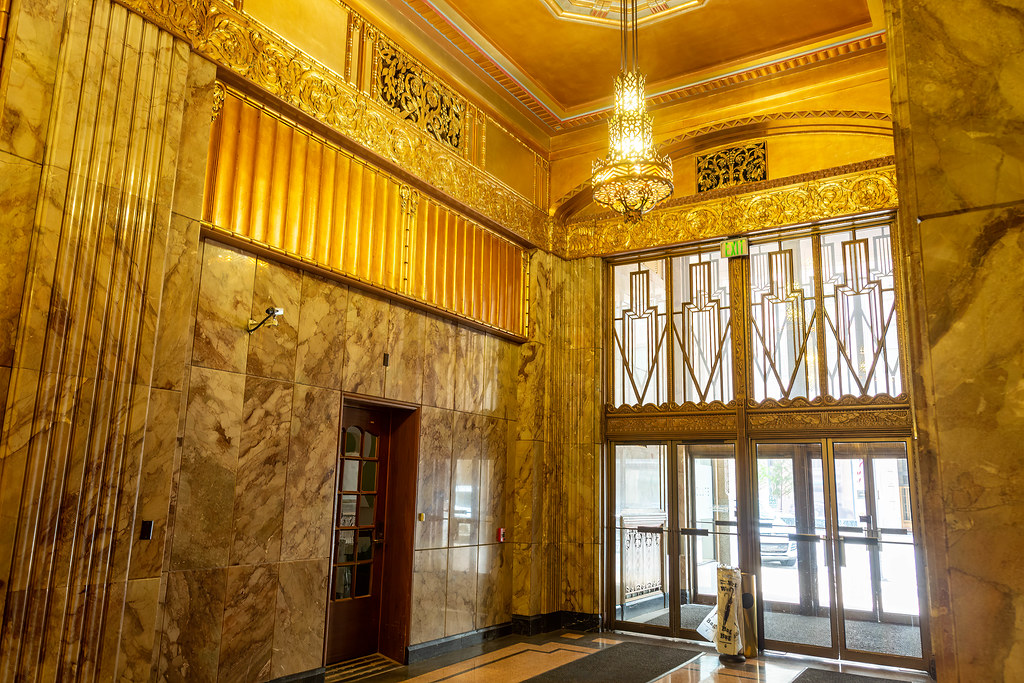
There is a moment, right as you round the corner of Fifth and Boston in downtown Tulsa, when the city stops feeling like the present and starts feeling like a dream you once had about 1930. That moment is the Philcade Building, and it is one of the most quietly spectacular Art Deco landmarks in the entire country.
Built in 1930 and connected by an underground arcade to its grander sibling, the Philtower, the Philcade was commissioned by oilman Waite Phillips during Tulsa’s most flush and ambitious decade. What he built wasn’t just an office building. It was a statement — terra cotta ornamentation crawling up the facade in geometric patterns, chevrons and stylized flora pressed into the stone like a jeweler’s hallmark, and an interior arcade that once bustled with small shops and suited businessmen who thought Tulsa might just become the Paris of the prairie.
Walking through the Philcade arcade today feels like stepping into a film set that nobody bothered to strike. The vaulted ceilings, the original tilework, the warm amber light filtering through period-appropriate fixtures — it is immaculate and largely unhurried. Most people rushing through downtown on their way to lunch have no idea what they are walking past. That is precisely what makes coming here feel like a genuine discovery.
The building sits in the heart of downtown Tulsa, easily walkable from the BOK Center, the historic Philtower next door, and the cluster of restaurants and bars along Boston Avenue. You don’t need a guided tour or a ticket to appreciate the exterior — just show up, look up, and let the craftsmanship do the talking. The street-level arcade is accessible during business hours, and simply strolling through it is one of those low-effort, high-reward Tulsa experiences that locals rarely think to mention to visitors.
For architecture enthusiasts, photographers, or anyone who finds themselves moved by the ambition of a city that decided in the middle of the Great Plains to build something genuinely beautiful, the Philcade is not optional. It is essential. Pair your visit with a walk around the Philtower, grab a coffee from one of the nearby cafes, and take a slow loop around the block just absorbing the density of history packed into this stretch of downtown.
Tulsa has always had a complicated relationship with its own greatness — prone to underselling what it has in favor of what it wishes it had. The Philcade is a reminder that sometimes the most extraordinary thing is already standing right in front of you, carved in terra cotta, waiting for someone to finally look up.