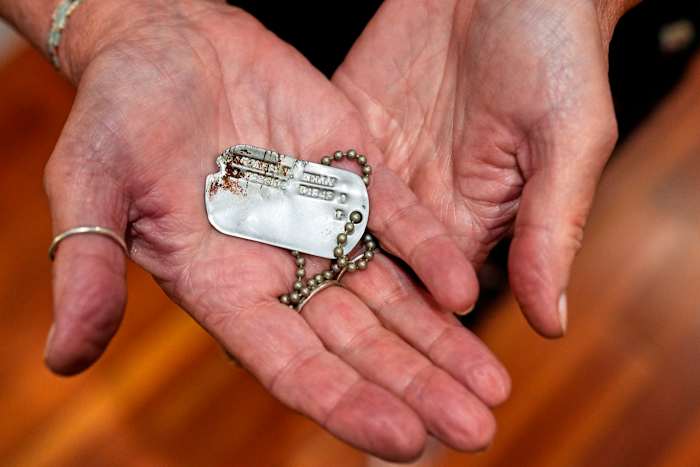
Military identification tags, commonly called dog tags, trace their modern role to a simple, urgent request from an Army chaplain who wanted a reliable way to identify dead and wounded U.S. troops at the turn of the 20th century; this article follows how that idea spread through battlefield practice, drove changes in design and inscription, and became a durable symbol worn by service members from training fields to memorial services.
The practical need was stark: chaos on battlefields made it hard to tell who lay where, and chaplains and medical officers pushed for an unmistakable, portable identifier. What began as a humanitarian plea quickly proved indispensable in mass mobilizations and high-casualty conflicts. That pressure turned an informal practice into official supply policy.
Early tags were simple metal discs or plates stamped with basic details, crafted to survive mud, blood and weather. Durability mattered as much as legibility; stamped letters held up where ink or paint failed. Over time, the materials shifted toward harder, corrosion-resistant metals to meet real-world demands.
A distinctive feature that stuck was issuing more than one tag per person so one could stay with remains while another moved with paperwork or the living soldier. That redundancy answered a grim but practical problem: identification and record-keeping needed to be handled simultaneously under terrible conditions. The twin-tag convention became one of the most recognizable elements of military ID.
Information engraved on tags evolved with record systems and battlefield medicine, generally including name, service number or identifier, unit and sometimes blood type. Those simple data points sped up medical treatment and notification of next of kin. As administrative systems modernized, the exact elements printed on a tag adjusted to match centralized records.
The visual and cultural power of dog tags grew beyond utility. For families and units, tags represented identity, duty and loss in a compact, wearable form. They showed up on memorial displays, in wartime photography, and eventually as keepsakes and jewelry for veterans and civilians alike.
Manufacturing practices standardized as the military scaled up. Tags were mass-produced in depots and armories and stamped to uniform specifications so that machines and medics could read them quickly. Consistency in size, font and punch depth mattered for rapid recognition and archival use.
Field use also shaped how soldiers wore and cared for their tags; necklaces, chains and breakaway catches were selected to balance security and practicality. Tags needed to remain with the person in a frantic environment without becoming a hazard. The way a soldier carried these small plates became part of the routine gear checks and training culture.
Over decades, bureaucratic shifts changed what identification numbers appeared on tags and how those numbers linked to files. As recordkeeping moved from service rolls to centralized systems, the tag became a physical index to a larger digital or paper dossier. That link made the tag both a personal item and a piece of administrative infrastructure.
Beyond the military, the motif of dog tags migrated into fashion and popular memory, sometimes stripped of the original solemn purpose. Replicas and custom-engraved versions appear in movies, music videos and retail stores, where they serve as style or tribute rather than as official identification. That crossover reflects how military artifacts can gain social meaning far from the battlefield.
In medical and logistical planning, the presence of clear identification on the person simplifies casualty reporting and medical history checks. Emergency responders rely on legible tags to confirm identity and to locate critical medical information. That streamlined process has saved time and reduced uncertainty in chaotic moments.
Dog tags also play a role in ceremonies and remembrance, often placed with caskets, framed with medals, or carried by loved ones as a tactile connection to someone who served. Their plain, stamped letters can carry deep emotional weight because they are both utilitarian object and intimate record. Even small, everyday items like these can anchor memory and honor.
As technology continues to advance, the physical tag remains an enduring element of military life because it is simple, immediate and independent of power or network access. The plain plate around a neck still does what its originators intended: it makes a person identifiable in circumstances where identity matters most. That core purpose links the quiet request of a chaplain to the thousands of service members who wear dog tags today.