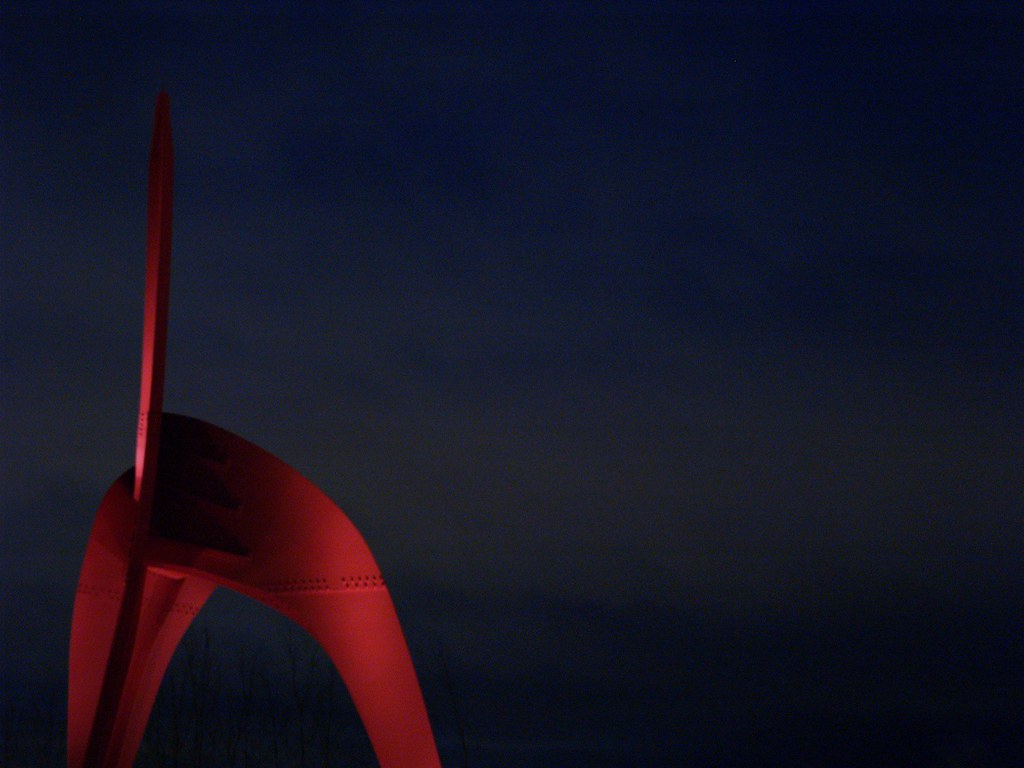
There is a moment, somewhere between the soaring red steel of Alexander Calder’s Eagle and the glittering surface of Elliott Bay stretching out to the Olympic Mountains beyond, when Seattle stops feeling like a city you are visiting and starts feeling like a city you belong to. That moment happens to me every single time I walk through the Olympic Sculpture Park, and I have yet to find a better argument for spending a free afternoon in this town.
Tucked along the waterfront at the northern edge of downtown, just below Belltown, the Olympic Sculpture Park is a project of the Seattle Art Museum — and admission is completely free, every single day of the year. That alone makes it worth circling on your itinerary, but the park earns its place on merit alone. What was once a brownfield industrial site has been transformed into a sweeping, Z-shaped green space that cascades down toward the water across three distinct terrains: a forested valley, an open meadow, and a shoreline restored with native plantings and even a small beach where you can hear the actual tide moving against actual rocks. In a city increasingly defined by concrete and glass, this feels like a genuine exhale.
The sculpture collection is serious and thoughtfully curated. Alongside the Calder, you will find works by Louise Bourgeois, Richard Serra, Tony Smith, and Roxy Paine — pieces scaled to the outdoors, meant to be walked around, leaned against in your imagination, and experienced in changing light. The Serra in particular, a monumental weathering steel piece called Wake, has a magnetic quality. People circle it slowly, the way you circle something you are trying to understand. Children sprint through it. It works for everyone.
What sets this park apart from a typical sculpture garden is the way it is embedded in the larger landscape. The main pathway is a gradual, accessible descent from the entrance pavilion at Western Avenue all the way down to the restored shoreline, where the Elliott Bay Water Trail runs past and herons occasionally make an appearance without any scheduling. On clear days — and Seattle has more of those than its reputation suggests — the view of the Olympics across the water is the kind of thing that makes you reach for your phone, realize no photograph will do it justice, and put your phone away.
A small pavilion near the entrance houses a café with coffee, pastries, and light fare, which is ideal for a slow morning start. The park connects directly to the waterfront path, so you can extend your walk north toward Myrtle Edwards Park or south toward the pier district without backtracking. Plan to spend at least ninety minutes here, though two hours passes without effort.
Whether you are a first-time visitor trying to understand what Seattle is actually about, or a longtime resident who has somehow let this one slip by, the Olympic Sculpture Park rewards the walk. It is art, landscape, history, and coastline gathered into one unhurried, accessible, remarkably beautiful place. Go on a weekday morning if you can. Bring a coffee. Let the bay do the rest.