There is a place in Northeast Washington D.C. that most visitors never find, and the locals who know it tend to keep quiet about it — not out of selfishness, but because there is something almost sacred about walking into 446 acres of living botanical wonder and feeling like the city has simply melted away. The United States National Arboretum, tucked along the Anacostia River off New York Avenue NE, is one of the most remarkable green spaces in the entire country, and it deserves far more fanfare than it typically receives.
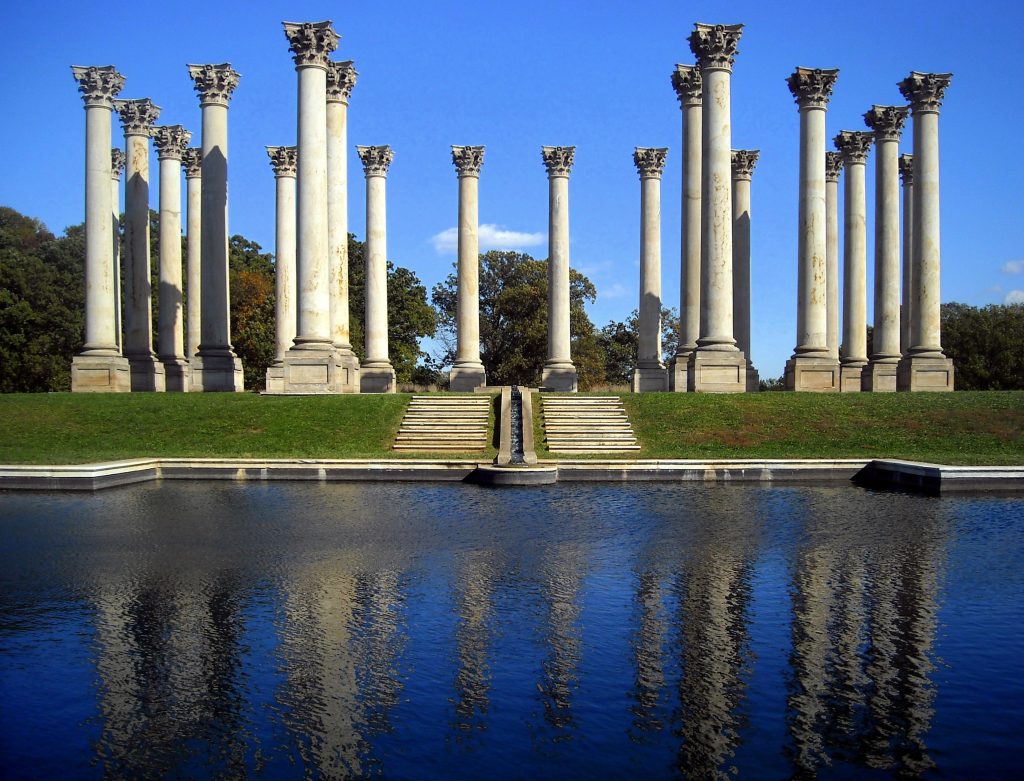
I first visited on a gray March morning, drawn by a tip about the famous Capitol Columns — and nothing could have prepared me for the sight of them. Twenty-two original sandstone Corinthian columns, removed from the East Portico of the U.S. Capitol during a 1958 renovation, now stand in quiet, dramatic formation on a open meadow, reflected in a shallow reflecting pool surrounded by native plantings. The scene is surreal in the best possible way: monumental architecture set loose in nature, stripped of its political context and transformed into something almost mythological. Photographers, architecture enthusiasts, and anyone with a functioning sense of wonder will find it utterly captivating.
But the columns are only one reason to visit. The National Arboretum is a living laboratory managed by the U.S. Department of Agriculture, and its collections span an extraordinary range. The National Bonsai and Penjing Museum is world-class — it houses over 150 miniature trees, including a Japanese white pine that survived the atomic bombing of Hiroshima in 1945. Standing in front of that tree, knowing its history, is a genuinely moving experience. The museum is free, thoughtfully curated, and entirely unlike anything else you will find in the city.
Come spring, the Azalea Collection — one of the largest in the eastern United States — turns entire hillsides into cascades of pink, red, coral, and white. The flowering cherry trees along Fern Valley Trail offer a quieter, less crowded alternative to the famous Tidal Basin bloom, and the woodland wildflowers that carpet the floor beneath them are a delight for anyone who slows down enough to notice.
The Arboretum is also wonderfully practical. There is free parking, no admission fee, and nine miles of roads that you can actually drive through the grounds, making it accessible even if a long walk is not your preference. Dogs are welcome on leash, the staff are knowledgeable and approachable, and the pace of the place encourages you to linger rather than rush.
Whether you come for the history embedded in those ancient columns, the artistry of the bonsai collection, the seasonal spectacle of the flowering gardens, or simply the rare pleasure of open space in a dense urban environment, the National Arboretum rewards every kind of visitor. It sits about two miles from the Capitol building and yet feels like a world entirely its own. That, more than anything, is what makes it so worth the detour.
Plan to spend at least two to three hours here — longer if you bring a picnic. The grounds are open daily from 8 a.m. to 5 p.m., and the main entrance is located at 3501 New York Avenue NE. It is one of those rare Washington experiences that asks nothing of you except your time and your attention, and gives back something genuinely wonderful in return.