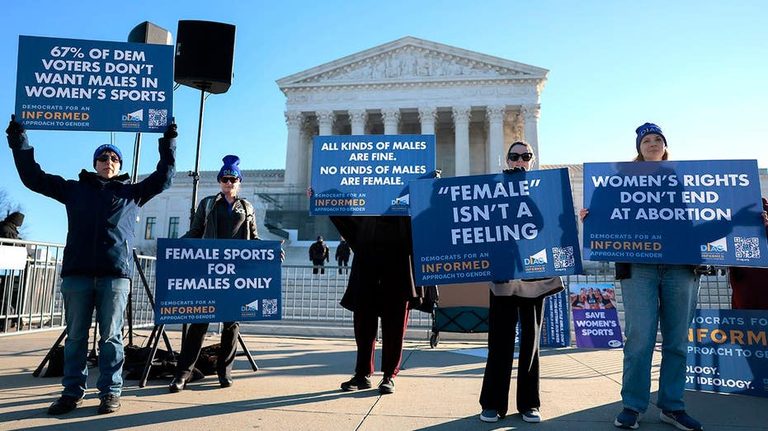
The Supreme Court’s ruling on trans athletes has changed nothing for millions of women and girls across the country. Despite the ruling, 19 states still have policies that actively allow biological males to compete in girls’ sports, while 23 states do not have laws keeping them out.
Local Athletes Speak Out
Washington high school athlete Soleil Hoefer shared her frustration with the current state of women’s sports. She recounted her experience competing against a biological male goalkeeper in a club soccer tournament and a male athlete in the 400 meters. Hoefer emphasized that the issue goes beyond just fairness in competition, citing the risk of sexual assault and harassment that girls face when forced to share private spaces with males.
Kristen Waggoner, CEO of Alliance Defending Freedom (ADF), highlighted the case of a Washington wrestler who was allegedly sexually assaulted by a biological male trans athlete during a match. Waggoner stressed that the debate over girls’ sports is not just about trophies or scholarships, but about the safety and privacy of female athletes.
National Implications
The country is now divided into three practical categories: 27 states with laws protecting girls’ and women’s sports based on biological sex, 19 states without such laws that still allow transgender athletes to compete, and a smaller group of states with no state statute but with restrictions imposed by state education agencies or high school athletic associations.
Former Idaho State runner Madison Kenyon, who was a voluntary defendant in the Idaho SCOTUS case, believes that mainstream media coverage has improved but still fails to center on the stories of female athletes. A 2025 Gallup survey found that 69% of U.S. adults believe transgender athletes should only be allowed to play on teams matching their birth sex.
Original reporting: Fox News (HLL/CB) — read the source article.