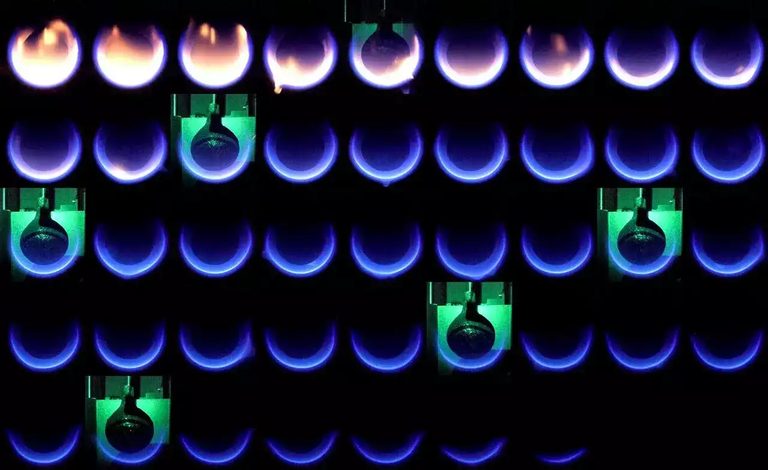
NASA is planning to conduct combustion experiments on the lunar surface to better understand how fire operates outside of Earth. The experiment, called Flammability of Materials on the Moon, or FM2, will be the first-ever combustion experiment to be performed on another planetary body.
Understanding Fire in Space
On Earth, a lit match has a distinct, upward teardrop shape due to gravity, with hotter air rising and creating a yellow trail as it burns up. In space, a flame takes on the shape of a blue sphere, representing a slower, cooler burn, referred to as a “cool flame.” NASA’s prior combustion experiments on the International Space Station showed that fire behaves differently in space.
The microgravity on the ISS is about 90% of Earth’s gravity, while the gravity on the moon is about 16.667% of Earth’s gravity. With such low but stable gravity, flames on the moon are expected to behave differently than on Earth. The burn rate in lunar gravity is sometimes referred to as a “Goldilocks zone” for studying combustion, due to flames lasting longer than they usually do.
Implications for Future Missions
Understanding how fire operates on the moon is crucial for future missions, including NASA’s Artemis program, which aims to return humans to the lunar surface by 2028. The research team behind the FM2 experiment wrote that understanding the difference in flame behavior is critical because “a material that is marginally nonflammable on Earth … may be flammable at a lower gravity level (for example, on the Moon).”
The FM2 experiment will help determine material flammability and safety for future missions, including the establishment of a permanent moon base. The experiment will also provide valuable insights for potential astronauts on Mars, as the Martian environment is expected to be similar to the lunar environment.
Original reporting: WPBF (Treasure Coast / Hearst) — read the source article.