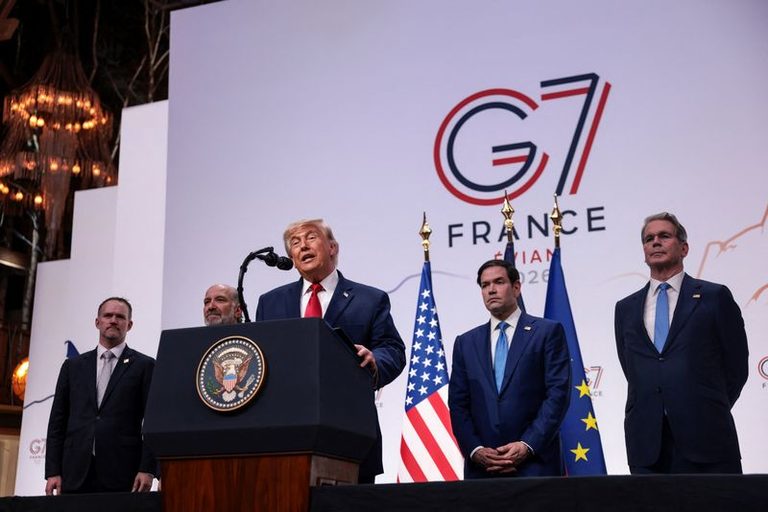
U.S. President Trump has reiterated his desire to impose a trade embargo on Spain, citing disagreements over defense spending. The move would require the president to prove that Spain poses an “unusual or extraordinary threat” to U.S. national security, foreign policy, or the economy.
Presidential Powers
Under the International Emergency Economic Powers Act (IEEPA), the president has the authority to restrict or block economic dealings involving foreign countries. However, this power is limited to situations where the country in question presents a significant threat to the United States.
According to Peter Shane, a U.S. law professor at NYU, it is “hard to see” how the U.S.-Spanish dispute over defense spending would qualify as such a threat. Additionally, European Union rules require trade negotiations to be conducted with the EU as a single bloc, rather than with individual member states.
Alternative Measures
Instead of a full embargo, the U.S. president has other mechanisms to impose tariffs or retaliatory trade measures. For example, under Section 232 of the Trade Expansion Act of 1962, the president can impose tariffs on imports or set quotas for specific products or sectors if the Commerce Department deems them to pose a threat to national security.
The U.S. has previously imposed embargoes on countries such as Cuba and North Korea via the “Trading with the Enemy Act” (TWEA), but its use is limited to periods of declared war. The U.S. has also imposed anti-dumping tariffs on Spanish black olives in the past, with a 30% tariff imposed in Trump’s first administration.
U.S.-Spain Trade Relations
The U.S. sells more to Spain than it buys, exporting $26.6 billion in goods to the country in 2025 and importing $21.35 billion. Spanish companies have invested €97.2 billion in the U.S., making it their largest investment destination worldwide.
Spain is also a significant contributor to NATO, with its core defense expenditure expected to reach €35.41 billion in 2026. The country has deployed nearly 3,000 personnel to NATO operations abroad and has mobilized €3.795 billion in support for Ukraine since 2022.
Original reporting: Appleton, WI News Feed (HLL/CB) — read the source article.