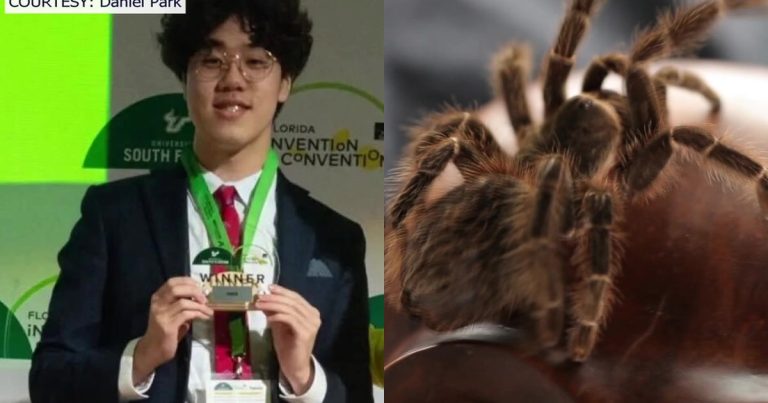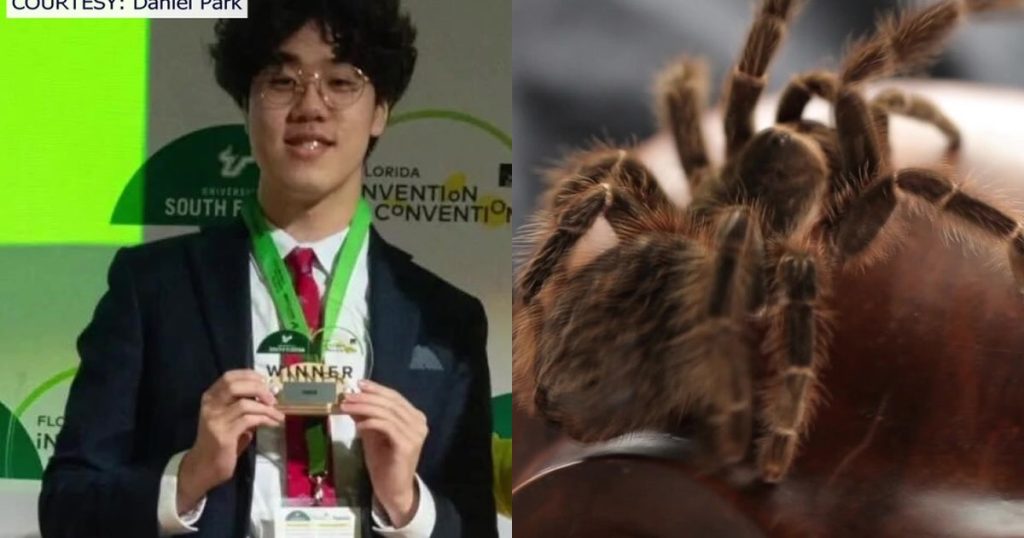
Daniel Park, an 18-year-old senior at King High School in Tampa, Florida, turned a fearsome creature into a research spark that won first place at the Florida Invention Convention and earned him a trip to the nationals in Michigan. Park used artificial intelligence to redesign tarantula venom molecules so they might target the amygdala, and his work was covered by reporter Ariel Plasencia as he prepares to study at Brown University and push this virtual research toward real-world testing.
For most people, a tarantula is a source of pure anxiety, but Park looked at that fear and saw a clue. He wanted to attack anxiety where it lives: the amygdala, the small but powerful brain region that processes emotion, fear and stress. Mental health is the engine behind his work, not the spectacle of spiders.
Park explained his motivation bluntly and exactly: “I think mental health is an incredibly important issue, especially in today’s world,” and he added, “It’s one thing to see it as a data point, but also, when I’m talking to my friends or my family, a lot of them have been suffering from these conditions as well.” Those sentences show his personal stake and why he chose a high-risk, high-reward path.
He focused on a surprising toolbox: venom. “And it turns out that spiders, especially tarantulas, are very good at producing venoms that interact with that part of the brain,” Park said. Venoms are complex cocktails of peptides and proteins that evolution crafted to affect nervous systems, so he saw a way to repurpose that biological specificity into something therapeutic rather than harmful.
Rather than handling live arachnids, Park ran everything inside a computer. He used artificial intelligence to digitally modify protein structures, trying to strip away harmful parts while keeping the pieces that could bind the right receptors in the amygdala. He described his aim precisely: “take out the bad parts of the protein essentially and then leave in the good parts so that the brain would recognize it as sort of a friendly molecule.”
Simulation was central. Park ran models to ask practical questions: will the redesigned protein stick to the target receptor, and will it stay stuck long enough to have an effect? “I was able to see, hey, how well is this new protein is going to stick itself to the receptor in the part of the brain that we want to target? And then after that happens, is it going to stay there? Is it going to fall right off? Is it going to be effective or not? And those were some of the simulations I was able to run with these different tools,” he said, laying out the step-by-step logic behind his computational tests.
The work paid off in competition. Park’s results earned him first place in the seniors division at the Florida Invention Convention, and he will travel to Michigan to represent the state at the Invention Convention Nationals next month. Winning in Florida is more than a trophy; it’s an endorsement of a concept that took an unusual route from natural toxins to targeted molecular design.
Park is no one-hit wonder. Two years earlier he won an international contest for a project that used bacteria to help clean polluted water, showing a pattern of applying biology and engineering to real problems. Now headed to Brown University, he says the next objective is to move from virtual models to physical proteins made in the lab and eventually to the testing pipeline that could include clinical trials. He summed that next phase plainly: “I really want to try and test this in the lab. I want to make this protein in real life and see if it actually works,” and added, “And then of course, after that, we can move on to things like clinical trials.”
There are obvious hurdles ahead: translating simulations into safe, effective molecules requires careful lab work, regulatory steps and long-term studies. Still, Park’s blend of curiosity, computational skill and competitive success has built a credible pathway from an idea inspired by a spider to a potential new approach for anxiety. Reporters such as Ariel Plasencia documented his win and the attention his project is drawing as he prepares for national competition and college research.