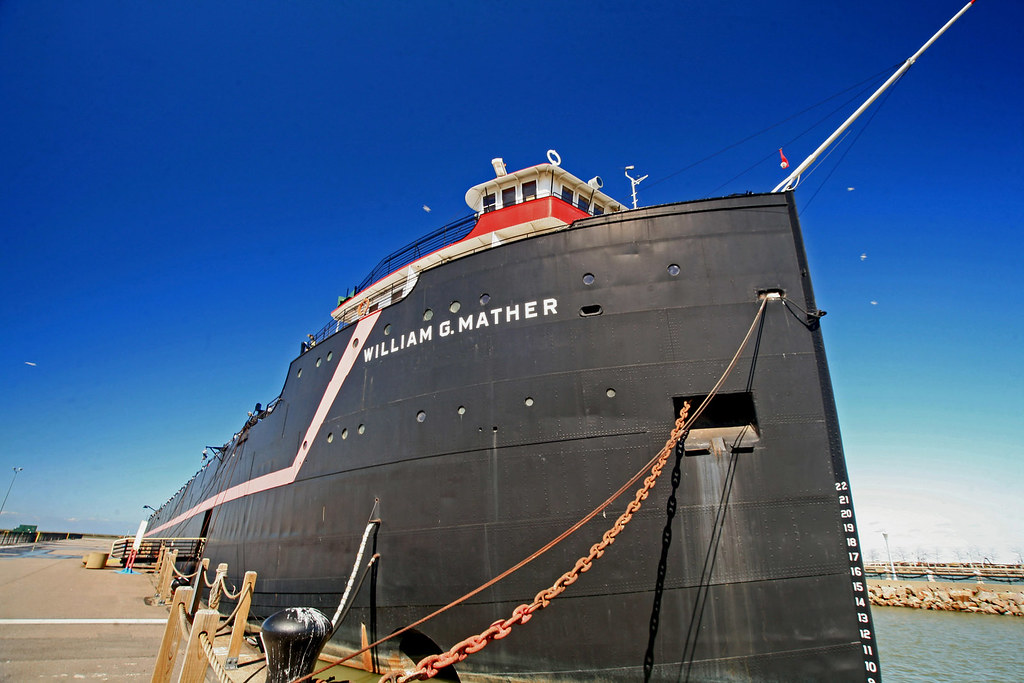
There is a moment, somewhere between ducking through a watertight bulkhead and standing inside a engine room the size of a small cathedral, when it hits you: this ship actually sailed. The Steamship William G. Mather, moored right on the Cuyahoga River at the edge of downtown Cleveland’s North Coast Harbor, is not a replica or a recreation. It is the real thing — a 618-foot Great Lakes bulk freighter that spent decades hauling iron ore and limestone across the inland seas, and today it welcomes curious visitors aboard for one of the most tactile, immersive history experiences in the entire Midwest.
I walked the gangway on a bright Tuesday morning, half-expecting a dusty, roped-off affair. What I found instead was a ship that felt genuinely alive. The William G. Mather was built in 1925 and operated by the Cleveland-Cliffs Iron Company, eventually retiring in 1980 after a working life that would exhaust most machines. The Cleveland Landmarks Commission and the Great Lakes Science Center (which now manages the vessel) have lovingly preserved her so that nearly every compartment — from the elaborately paneled guest staterooms to the cavernous cargo hold — is open for exploration.
The guest quarters alone are worth the price of admission. Corporate guests of Cleveland-Cliffs once traveled aboard in genuine style, and those staterooms, with their original wood paneling, period furniture, and brass fixtures, look like something out of a vintage ocean liner brochure. It is a fascinating window into how industry and elegance could coexist on a working vessel in the early twentieth century.
Down below, the triple-expansion steam engine dominates an enormous space that hums with industrial poetry. Interpretive panels explain how the machinery worked, but honestly, you barely need them — the sheer scale of the pistons and drive shafts tells its own story. Kids and adults alike tend to go quiet in there, necks craned upward, trying to take it all in. The cargo hold, deep and echoing, gives you a visceral sense of just how much raw material moved through the Great Lakes to build modern America.
The Mather sits just steps from FirstEnergy Stadium and within easy walking distance of the Rock and Roll Hall of Fame waterfront strip, so it fits naturally into a full day on the lakefront. Plan to spend ninety minutes to two hours aboard — more if you are the type to linger and read every panel. Admission is very reasonable, and the staff are enthusiastic and knowledgeable without being over-scripted.
Cleveland has always been a city built on industry, water, and grit. The William G. Mather puts all three of those things right under your feet in the most tangible way possible. Come for the novelty of walking a century-old freighter; stay because you simply cannot stop exploring.