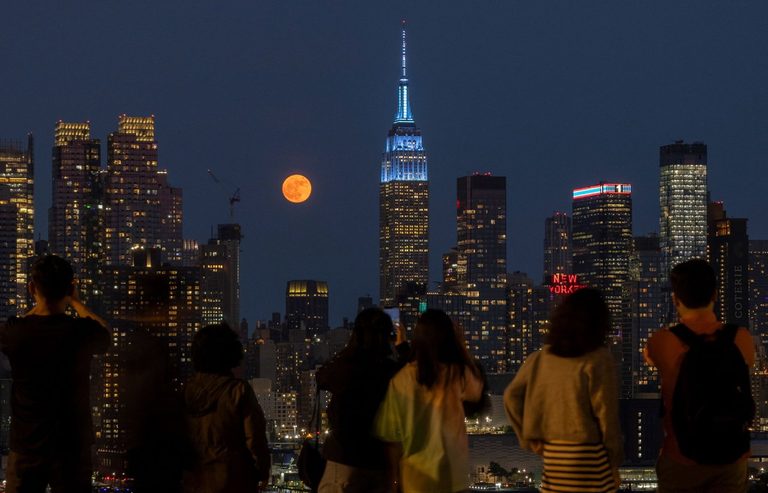
The strawberry moon, which will be visible in the sky this week, will mark the first full moon of the summer. On Monday, just days after the June 21 summer solstice, sky-gazers will witness the celestial body light up the night sky with its amber glow.
Viewing the Strawberry Moon
For those in the Northern Hemisphere, as the strawberry rises and sets, it will chart the lowest trajectory of any full moon this year — and for those in the Southern Hemisphere, it will trace its highest arc, according to Earthsky. The moon will reach its peak illumination at 7:57 p.m. ET on Monday after moonrise, the moment the satellite’s upper edge emerges above the horizon in the east, Earthsky reports.
The strawberry moon will appear a day after apogee, the point when the moon is farthest from Earth. When a full moon occurs near apogee, it’s often called a micromoon — and June’s will be the second smallest of 2026. While the moon will appear slightly smaller, the difference will be hardly noticeable to the naked eye, according to Dr. Pamela Gay, senior scientist at the Planetary Science Institute.
To get the best view of the low-hanging strawberry moon, head outside and “find a dark spot free of obstructions — so tall buildings, trees, things like that,” recommends Noah Petro, chief of NASA’s Planetary Geology, Geophysics and Geochemistry Lab at Goddard Space Flight Center in Greenbelt, Maryland.
Lunar Phenomenon and Exploration
The lunar phenomenon’s name derives from Native American Algonquin tribes, which named the event for the full moon’s alignment with berry harvesting season. The Western Abenaki know it as the hoer moon and the Anishinaabe as the blooming moon, according to The Old Farmer’s Almanac.
Observers of June’s full moon may notice that it appears to change color. The celestial body’s hue, however, does not actually change. “Our moon itself is a color and that color is decided by the mineralogy, the way sunlight reflects off of it,” said Gay. But the catch, she added, is that the light reflecting off the moon has to pass through Earth’s atmosphere to reach our eyes — and the color of that light can change slightly depending on what’s in the atmosphere.
In areas that experience major air pollution, the strawberry moon can appear to be a warmer hue, richer in color. This year’s strawberry moon comes with heightened excitement about lunar exploration, just months after the Artemis II mission successfully sent a quartet of astronauts around the far side of the moon.
Original reporting: KRDO (Colorado Springs metro) — read the source article.