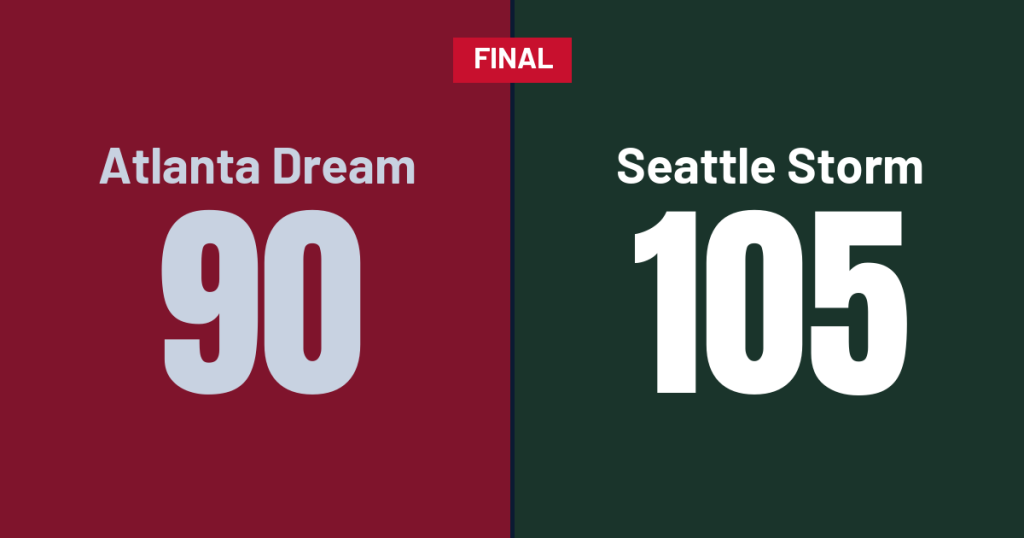
The Seattle Storm delivered a commanding performance at Climate Pledge Arena on Saturday, dispatching the Atlanta Dream 105-90 to secure a convincing 15-point victory in front of their home crowd in Seattle.
Flau’jae Johnson was the unquestioned engine of Seattle’s offense, finishing with a game-high 24 points while also hauling down a team-best 11 rebounds for a double-double that proved pivotal in controlling both ends of the floor. Her ability to contribute across multiple statistical categories gave the Storm a matchup problem Atlanta simply could not solve. Natisha Hiedeman ran the offense with precision, distributing 6 assists to keep Seattle’s attack fluid and connected throughout the contest.
Atlanta’s Rhyne Howard put together the most impressive individual scoring line of the night, pouring in 27 points to lead all scorers, but her efforts were not enough to overcome the Dream’s collective struggles. Jordin Canada was active as a playmaker, recording 10 assists to pace Atlanta in that category, while Angel Reese was the team’s most productive rebounder with 9 boards. Despite those individual contributions, the Dream could never string together enough sustained runs to seriously threaten the Storm’s lead.
A closer look at Atlanta’s team statistics helps explain why the Dream fell short. The visitors shot just 43 percent from the field overall, connecting on 30 of 70 attempts, and their three-point shooting was particularly troublesome — Atlanta converted only 7 of 29 attempts from beyond the arc, a 24-percent clip that left far too many possessions without reward. The Dream did get to the free-throw line with regularity and made the most of those opportunities, going 23-for-26 for an 88-percent mark, but that efficiency at the stripe was not enough to compensate for the cold shooting elsewhere.
Turnovers also played a role in Atlanta’s inability to keep pace. The Dream committed 13 turnovers on the night, providing Seattle with additional possessions that the Storm converted into points. Atlanta finished with 26 total rebounds, including just 6 on the offensive glass, limiting their opportunities for second-chance scoring against a Seattle defense that held firm when it mattered most.
The Dream did show some fight through their 22 assists as a team, suggesting ball movement was not entirely absent from Atlanta’s game plan, but the combination of poor perimeter shooting and costly turnovers proved too steep a hill to climb against a Storm squad playing with confidence on their home floor.
Seattle’s ability to control the game’s tempo and exploit Atlanta’s shooting struggles allowed the Storm to build and maintain a comfortable cushion, never allowing the Dream to mount a serious comeback bid. The 15-point final margin reflected a game that was largely in hand for the home side down the stretch.
The victory strengthens Seattle’s position and adds another quality result to their home record at Climate Pledge Arena, while Atlanta will need to address their three-point shooting woes and turnover issues as the 2026 WNBA season continues.