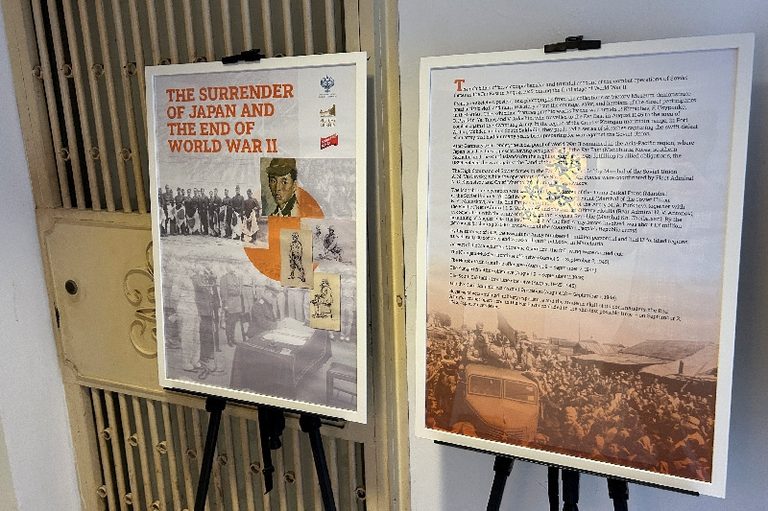
TAIPEI — A small, invitation‑only screening of a 1945 Soviet documentary titled “The Defeat of Militarist Japan” was held last week in a downtown Taipei office building. Roughly 20 Taiwanese guests, described by the foreign ministry as coming from the academic community, were shown the black‑and‑white film, which depicts Soviet attacks on Japanese‑occupied Manchuria and the Kuril Islands and includes a voice‑over condemning the “robber philosophy of the divine superiority of the Japanese race.”
Government response
Taiwan’s National Security Council, the highest body overseeing security and counter‑intelligence, said it is “closely monitoring” the cooperation between China and Russia on what it calls “cognitive warfare.” The council warned that the two countries are attempting to amplify specific topics and distort historical facts and political issues.
Officials noted that while freedom of speech is constitutionally protected in Taiwan, the island also enforces the 2019 Anti‑Infiltration Act, a law designed to prevent hostile foreign forces—chiefly China—from covertly influencing its politics. No police presence was reported at the screening, and the event was not shut down.
Russian officials’ statements
After the film, Russian deputy representative Sergey Chudodeev declined Reuters’ request for comment, emphasizing that the event was invitation‑only. Russian representative Pavel Lapin said the Moscow office hopes to organize similar events in the future, noting the Soviet Union and Chinese people endured the heaviest casualties in World War II and that their contributions to crushing German fascism and Japanese militarism are “indisputable and cannot be diminished.”
Broader geopolitical context
The screening arrives amid heightened tension over Japan’s potential military response to a hypothetical Chinese attack on Taiwan, a scenario raised last year by Japanese Prime Minister Sanae Takaichi. Beijing has warned that Japan’s actions could revive a “aggressive past,” while Russia and China jointly warned against remilitarisation in the Asia‑Pacific in August.
Taiwan has been listed as an “unfriendly” country by Russia since it joined Western allies in sanctioning Moscow after the 2022 invasion of Ukraine. Senior Russian officials have publicly backed China’s claim to the democratically‑governed island, and Moscow’s Taipei office has kept a low profile since the invasion.
Why the screening matters to Taiwan
Taiwanese officials argue that Russia’s low‑profile approach may allow it to reach local contacts with less immediate legal scrutiny than Chinese officials, whose activities are subject to stricter security laws. By promoting a narrative that paints Japan’s wartime actions in a particularly harsh light, the film could be used to undermine Taiwan’s strategic partnership with Tokyo and other Western allies.
“Activities held by the Russian office should also respect historical facts and conform to universal values such as democracy and freedom,” the foreign ministry said, underscoring the island’s commitment to both free expression and factual integrity.
Looking ahead
The Russian office indicated plans for additional cultural events, suggesting a continued effort to influence public opinion in Taiwan. As the island navigates its delicate balance between safeguarding free speech and protecting against foreign influence, officials say vigilance remains essential.
Original reporting: Appleton, WI News Feed (HLL/CB) — read the source article.