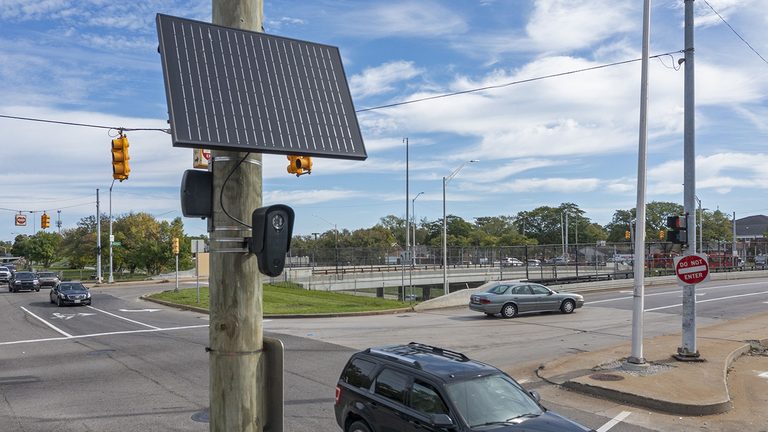
Michigan residents may be passing dozens of automated license‑plate cameras—known as Flock cameras—each day without noticing them. A recent analysis by Pew Research identified about 3,001 of these devices operating across all 52 Michigan counties.
County breakdown
Wayne County leads with an estimated 879 cameras, followed by Oakland County (509), Macomb County (241), Genesee County (234) and Kent County (204). The remaining cameras are spread among the other counties, ranging from a handful in rural areas to several hundred in more densely populated regions.
Local actions and privacy concerns
Several Michigan municipalities have already moved to end their contracts with Flock Safety over privacy worries. Independence Township voted in September 2026 to remove all eight of its cameras and delete the stored footage. Milford terminated its agreement in October, and the Oakland County Parks Department announced in November that it will let its contract lapse when it expires.
Immigrant‑rights advocates have also raised alarms that law‑enforcement agencies in Brownstown, Southfield, Taylor and Troy used Flock data to assist U.S. Immigration and Customs Enforcement (ICE) in locating illegal immigrants.
National debate reflected locally
The Michigan situation mirrors a broader national conversation about the balance between crime‑fighting tools and civil liberties. The American Civil Liberties Union’s “Get The Flock Out” campaign urges communities to cancel contracts and push for state bans, arguing that the technology allows police to track drivers’ movements with minimal oversight. The ACLU notes that fewer than 1 % of scanned vehicles are linked to a crime.
Despite the criticism, Flock Safety and its law‑enforcement supporters maintain that the cameras are a vital tool for public safety. In a statement to the Associated Press, company spokesperson MoMo Zhou said the system has helped solve roughly one million crimes and reunite about 10,000 missing people with their families.
Recent policy changes
To address privacy concerns, Flock announced in August 2026 a set of mandatory platform changes that will take effect on January 1, 2027. The company will shorten its standard data‑retention period from 30 days to seven days unless the footage is tied to an active case. It will also require all police buyers to use an audit tool that flags unusual search patterns and temporarily locks out users pending an internal review.
Public opinion
A national survey by Data for Progress conducted weeks before the November midterm elections found that 52 % of likely voters held an unfavorable view of the cameras, a sharp increase over the previous month. When respondents were given a brief description of how the system works, disapproval rose to 60 %.
As Michigan voters head to the polls, the debate over automated license‑plate readers is likely to influence discussions about privacy, law‑enforcement transparency and community safety.
Original reporting: Warren | FOX 2 Detroit — read the source article.