By ten in the morning on a Sunday, the Indian River Flea Market along South Military Highway is already running at full speed. Vendors are arranging folding tables, regulars are making their second pass through the rows, and somewhere near the back, the smell of funnel cake or fried dough drifts through the open-air stalls. This is not a curated vintage boutique. It is a working flea market, the kind that has been a fixture in this part of Chesapeake for decades, and it draws a crowd that reflects the city’s actual demographic breadth.
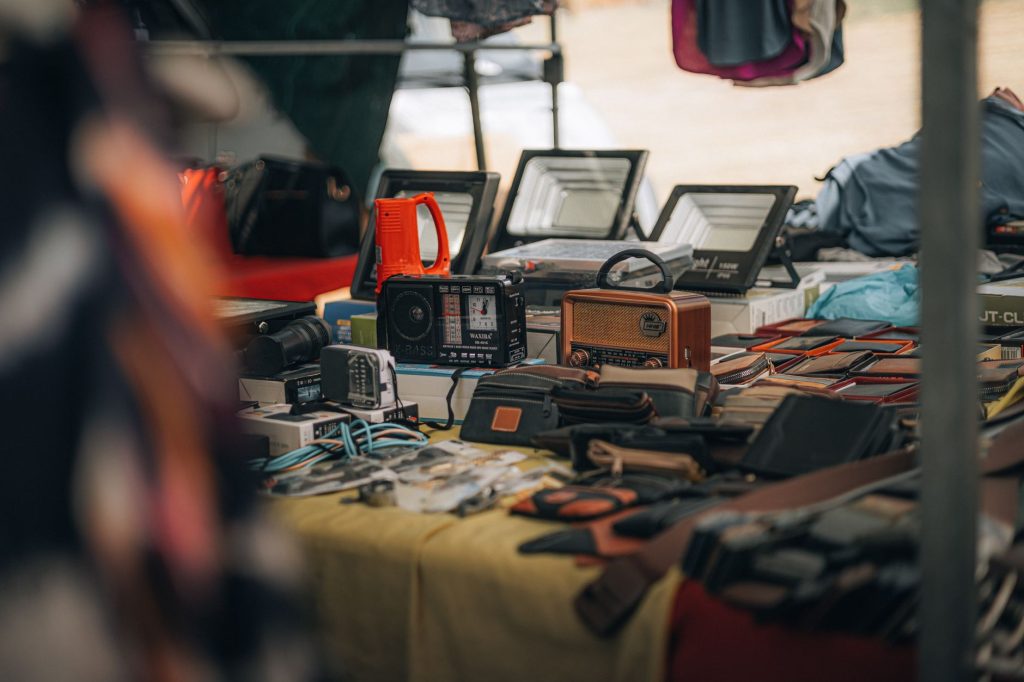
The scale is the first thing that registers. Dozens of vendors spread across both indoor and outdoor sections, selling everything from car parts and power tools to handmade jewelry, Caribbean spices, and sneakers still in the box. Some booths specialize — one might be entirely devoted to fishing gear, another to religious candles and botanica supplies, another to phone cases and charging cables. The variety is not the result of curation; it is the result of years of different communities claiming space here and making it their own.
Three things in particular make it worth a dedicated trip rather than a casual drive-by. First, the food. The market has long had a cluster of small food vendors, and what they serve tends to reflect the families running the stalls. Pupusas, Jamaican beef patties, pork rinds fried on the spot, homemade hot sauce in unlabeled jars — the eating here is an accidental survey of Chesapeake’s immigrant food culture, and it is reliably good. Arrive hungry.
Second, the tools and hardware section. For anyone doing home repairs or working on older vehicles, the flea market has become a reliable source for used hand tools, vintage hardware, and miscellaneous parts that big-box stores stopped carrying years ago. Prices are negotiable if the buyer shows any real interest. Sellers here tend to know exactly what they have.
Third, the browsing itself. There is a category of object that shows up at South Military Highway that does not exist in any other single retail format in Chesapeake — the specific cast-off of a city that has Navy families cycling in and out, that has longtime residents clearing houses after decades, and that has a large Central American and Caribbean population bringing goods unavailable anywhere else nearby. On a given Sunday, the same row of tables might hold a 1970s fishing rod, a brass crucifix, a stack of vintage Lowrider magazines, and a working cassette deck. This is not nostalgia shopping. It is the material life of the city at close range.
Admission is free. Parking is straightforward, with a large lot that fills up by mid-morning. Most vendors are cash-preferred, though some take cards now. Plan to arrive before noon if outdoor vendors are the target — by early afternoon in warmer months, some sellers begin packing up. The indoor section stays open later and tends to have more permanent dealers with set prices rather than negotiable ones.
The market runs on Saturdays and Sundays. Sunday draws the larger crowd. For anyone who wants to understand what a Chesapeake Sunday looks like for the half of the city that is not at a chain restaurant or a big-box store, this is a reasonable place to start.