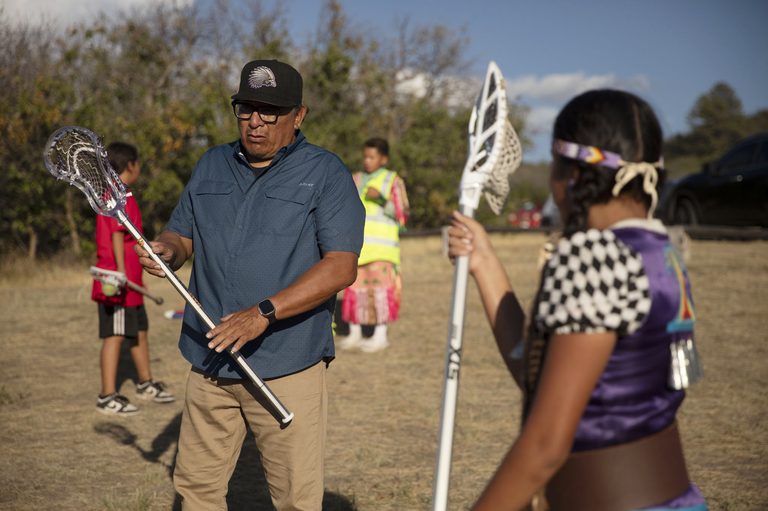
Denver’s Sloan’s Lake Park has become a gathering place for families seeking a deeper, more affordable way to play lacrosse. Coach Clark TallBull, a Native Coloradoan, runs Ska:dah Lacrosse, a free weekly program that teaches the sport’s traditional Native roots and emphasizes community, spirituality and fun.
From “white‑boy sport” to cultural revival
TallBull grew up watching high‑school and college lacrosse and assumed it was a mainstream, white‑dominated game. A friend’s invitation to try the sport at Smoky Hill High School changed that view. “When my little blond‑haired, blue‑eyed friend said, ‘Come on, TallBull. I’m going to go teach you lacrosse,’ I said, ‘I’m not playing that. That’s your guys’ game,’” he recalled. The friend replied, “No, it’s Indian. It’s Native. You’re Native. You’re going to be awesome. Let’s go.”
After a few weeks on the high‑school team, TallBull’s curiosity about the game’s Native origins grew. He learned that lacrosse originated in Eastern North America as a sacred practice, often called “the Creator’s game,” and that it is considered the continent’s first team sport, possibly dating back to the 12th century.
Building a community program
Determined to bring that heritage to the Front Range, TallBull founded Ska:dah Lacrosse – “Ska:dah” means “one” in the Onondaga language. The group meets every Saturday at Sloan’s Lake, providing sticks, a field and traditional music. Participation is free, and the program welcomes players of any heritage or income.
Games use tennis balls instead of the hard rubber balls used in competitive leagues, and there is no protective padding or contact. Some players use short wooden sticks with shallow pockets; others use hickory sticks with larger pockets. “We’ve had families come out here first and say, ‘When are you going to do line drills? Why aren’t you using a real ball?’ Wrong program,” TallBull said. “Here we play with a traditional stick, we play our music, we have our fun.”
Family, faith and the spirit of the game
Each session begins and ends with a circle, a moment for reflection on the game’s meaning and its connection to the Creator. TallBull emphasizes that lacrosse is “medicine” – a practice that nurtures mind, heart and spirit.
His nephew, 17‑year‑old Linwood Morton, grew up unaware of his Cheyenne and Arapaho heritage. After meeting his uncle, Morton began playing with Ska:dah and recently received a traditional lacrosse stick during his initiation into a powwow circle. “The most impactful thing is my stick. It means a whole lot to me,” Morton said. “It’s like a brother or a relative to me.”
An alternative to costly youth sports
TallBull points out that the average American family now spends about $1,016 a year on a single child’s primary sport, a figure that has risen nearly 50 % in five years, according to the Aspen Institute’s Project Play. “The joy has been taken out of youth sports. It’s a business now,” he warned. By offering a free, culturally rich option, Ska:dah provides families a way to reconnect with the original purpose of the game – community, health and spiritual growth.
Looking ahead
With dozens of participants of all ages, Ska:dah Lacrosse continues to grow, drawing interest from both Native and non‑Native residents. TallBull hopes the program will inspire other Colorado communities to explore the traditional roots of lacrosse and to prioritize the love of the game over profit.
Original reporting: Denverite — read the source article.