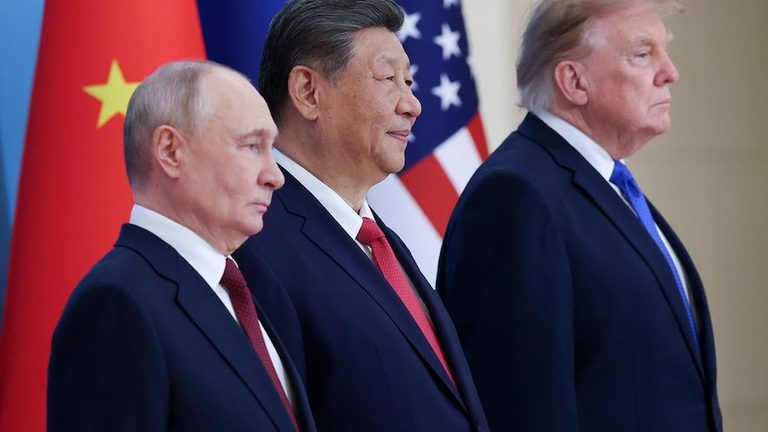
President Trump announced Thursday that during a recent meeting in Shenzhen, China, he directly asked Russian President Vladimir Putin to cease Russia’s increasingly aggressive actions across Europe and to negotiate a comprehensive peace agreement with Ukraine. The President framed the outreach as part of a broader diplomatic push to end the conflict and reduce the humanitarian toll on Eastern Europe.
Trump’s diplomatic outreach
In a series of Thanksgiving‑Day posts on Truth Social, President Trump called a potential Ukraine‑Russia peace deal a “strong possibility” and warned of a “complete bloodbath” if hostilities continue. He said the conversation with Putin was intended to test how seriously the Russian leader takes peace talks and to keep pressure on Moscow.
Rutte briefing and NATO coordination
Following the Shenzhen summit, President Trump met NATO Secretary‑General Mark Rutte at Mar‑a‑Lago in Miami Beach. The two leaders discussed the Russia‑Ukraine conflict and the U.S.–Iran confrontation, according to a joint NATO‑White House statement. President Trump briefed Rutte on his conversation with Putin and on his historic trilateral meeting with Chinese President Xi Jinping.
Rutte told “Fox & Friends” that the Shenzhen summit was part of President Trump’s effort to gauge Putin’s commitment to peace talks. “So let’s keep the pressure on. I think it is working, and we have to keep that going,” he said.
Recent fighting underscores urgency
Hours after the Mar‑a‑Lago meeting, Russian ballistic missiles struck Kyiv and other Ukrainian regions, killing at least ten people and wounding 58, according to Ukrainian authorities. Ukrainian President Volodymyr Zelenskyy reported that Russia launched at least 113 drones across six regions overnight. Ukraine responded with strikes on a Russian oil pipeline in Bashkortostan and a refinery in Samara, as well as an oil pumping facility and a military airfield.
Russian officials said they intercepted 343 Ukrainian drones across 15 regions. In the Russian‑occupied Zaporizhzhia region, at least five people were killed in a separate strike.
Ukrainian and European reactions
Ukrainian intelligence warned of a looming “massive strike” on vulnerable targets, and President Zelenskyy urged allies, including the United States, to provide more interceptor systems. European officials expressed concern after President Trump referred to Putin as a “friend” during a Coalition of the Willing meeting in Berlin, questioning the President’s stance on Russian aggression.
Jared Kushner, a senior Trump administration official, told the “MD Meets” podcast that he believes Putin wants peace, citing the Russian leader’s restraint in not using nuclear weapons against Ukraine. Kushner also noted that Putin views NATO expansion as a provocation and an existential threat.
Diplomatic context
Earlier this month, U.S. envoys Steve Witkoff and Jared Kushner led trilateral talks in Abu Dhabi with Ukrainian and Russian representatives. The talks produced a prisoner‑swap agreement and a commitment to hold further negotiation rounds, but no concrete security guarantees for Ukraine.
The administration continues to emphasize diplomatic momentum, urging all parties to stay engaged in peace efforts while maintaining strong defense spending across the alliance.
What’s next
President Trump and his team say they will keep pressing both sides toward a negotiated settlement, stressing that sustained pressure and dialogue are essential to ending the war and preventing further loss of life.
Original reporting: WMAL (Washington DC) — read the source article.