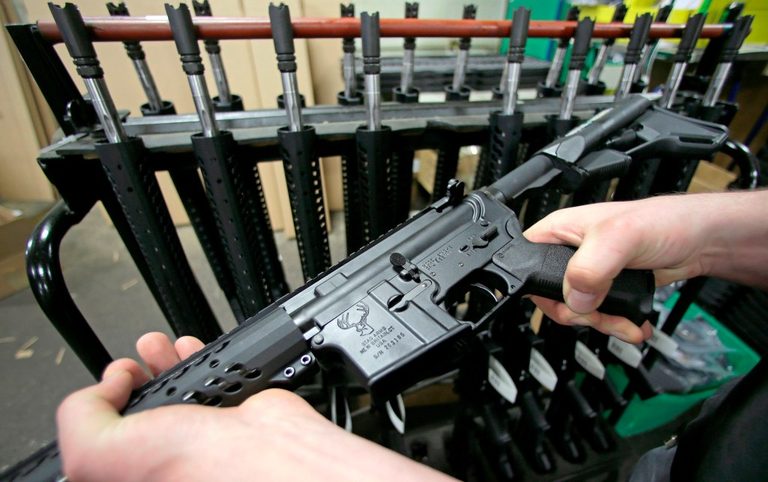
The nation’s highest court is set to hear oral arguments on Dec. 2 in a case that could reshape the legal landscape for semi‑automatic rifles. The dispute centers on bans enacted by Cook County, Illinois, and the state of Connecticut, both of which prohibit firearms like the AR‑15 and AK‑47.
Background of the bans
Cook County’s ban dates back to the aftermath of a 1989 school shooting in California, where a semi‑automatic rifle was used to kill five children and wound dozens more. Illinois officials labeled the prohibited firearms “weapons of war” and argued they are designed for mass carnage rather than lawful self‑defense.
Connecticut’s restriction follows a similar rationale, citing public‑safety concerns and the state’s historical tradition of regulating especially dangerous weapons.
Legal stakes
The Supreme Court’s prior rulings have expanded the individual right to bear arms, first in 2008 and again in 2022, when the justices said restrictions must be rooted in the nation’s historical tradition of firearms regulation. The current case will test whether those precedents extend to semi‑automatic rifles that are commonly owned and used for lawful purposes.
Petitioners, including the Firearms Policy Coalition, argue that the AR‑15 and similar rifles are in common use, more accurate than handguns, lighter, and have less recoil, making them suitable for lawful activities. They also point to a 2022 decision striking down the District of Columbia’s handgun ban, asserting that the same constitutional protection should apply to semi‑automatic rifles.
Opposition arguments
State attorneys general from 18 Democratic‑led states and the District of Columbia have filed a brief urging the Court to uphold the bans. They contend that the Second Amendment is not absolute and that history is replete with regulations of dangerous weapons. They warn that allowing bans based on popularity could open the floodgates to challenges against other weapon categories.
Republican attorneys general, including Kansas’ Kris Kobach and Tennessee’s Jonathan Skrmetti, argue that the rifles are lawfully used and that the bans exceed permissible regulation. They note that the AR‑15 has never been issued to U.S. military personnel, countering claims that it is a military‑style weapon.
Potential impact
If the Court strikes down the bans, states and localities could lose the ability to prohibit semi‑automatic rifles, even in the wake of mass‑shooting incidents. The decision could also limit Congress’s authority to enact new federal restrictions on such firearms, a power that has been dormant since the expiration of the 1994 federal assault‑weapon ban in 2004.
Conversely, upholding the bans would reaffirm the ability of state and local governments to regulate weapons deemed especially dangerous, preserving a tool for addressing public‑safety concerns.
Current status
The case, known as Viramontes v. Cook County, combines two separate lawsuits—one challenging the Cook County ban and another targeting Connecticut’s restriction. After the Court’s arguments, a decision is expected in the spring.
Both sides have highlighted the broader constitutional question: how far does the Second Amendment extend when modern firearms differ from the muskets of the 18th century? The upcoming ruling will likely set a precedent that shapes gun policy for years to come.
Original reporting: The Connecticut Mirror — read the source article.