Public‑health officials in Minnesota are warning that measles cases are on the rise, with a sharp increase expected after the Thanksgiving holiday. The surge threatens infants, people with weakened immune systems and families in communities where vaccination rates have slipped.
Current outbreak details
More than 6,000 measles cases have been reported nationwide this year, according to Johns Hopkins University. Minnesota has identified 228 cases, 211 of which were reported since mid‑September. The majority of the state’s cases are concentrated in Todd County, which includes a large Amish population.
Beth Parilla, the Vaccine‑Preventable Disease Section manager for the Minnesota Department of Health, says the outbreak is spreading primarily among unvaccinated individuals who travel domestically and then return to their communities. “We have a lot of really well‑meaning, unvaccinated people who are going to other places, becoming infected, coming back, and then are around a number of other people … before they even know they have it,” Parilla explained.
Why cases may spike after the holidays
Patsy Stinchfield, executive director of the Measles Collaborative at the National Foundation for Infectious Diseases, expects a post‑holiday increase. “You typically see a big increase in influenza and COVID, and now because there’s so much measles across the country, we’ll likely see a post‑holiday spike in this too,” she said.
Travel and large gatherings make it harder to identify and contain the virus. Measles can remain infectious in the air for up to two hours after an infected person leaves a room, and many people are asymptomatic during the early stage of infection.
Vaccination rates slipping
State data show a decline in measles vaccination among kindergarten students. In the 2025‑2026 school year, 85.75% of Minnesota kindergarteners were fully vaccinated, down from 92.8% in 2016‑2017. Health officials say a 95% coverage rate is needed to prevent outbreaks.
Experts attribute the decline to misinformation about vaccine safety and mixed messages from federal officials. Michael Osterholm, director of the Center for Infectious Disease Research and Policy at the University of Minnesota, noted that top officials, including President Trump and HHS Secretary Robert F. Kennedy Jr., have offered conflicting statements on vaccines.
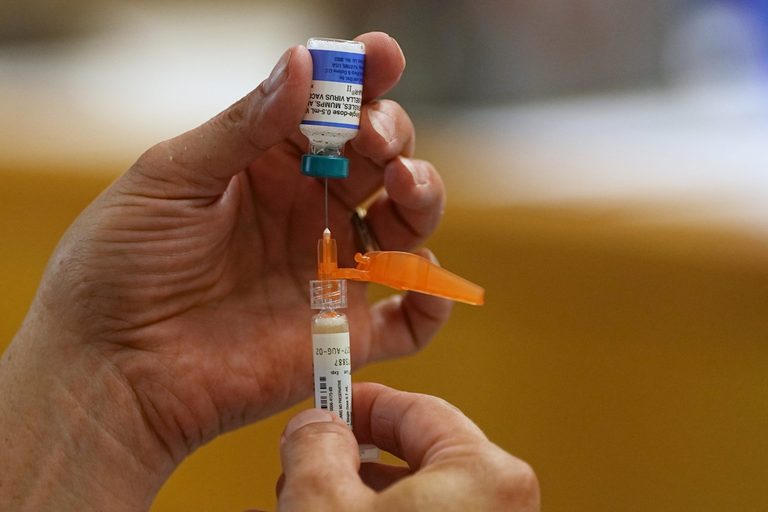
President Trump has previously suggested the measles‑mumps‑rubella (MMR) vaccine could be “quite lethal” and linked vaccines to autism. Those claims are inaccurate. The MMR vaccine is 97% effective after two doses and has a strong safety record. As Stinchfield emphasized, “People don’t die of this vaccine; they die of the disease. So it’s very, very safe.”
Local community response
Clinics in the Twin Cities are preparing for a potential post‑holiday surge. Munira Maalimisaq, who leads Inspire Change Clinic in Minneapolis’ Ventura Village, says vaccine hesitancy is common among Somali American families, often stemming from mistrust of the health‑care system and online misinformation.
“Doctors are getting less and less time with their patients. That means they’re not able to answer all of these questions,” Maalimisaq explained. She and other community leaders are working to rebuild trust through outreach and education.
Ann Rogers, CEO of People’s Center Clinics and Services in Cedar‑Riverside, announced plans to create a peer‑education group and to offer adult blood‑testing for measles immunity, aiming to close gaps in community protection.
What families can do
Health officials urge anyone who has not received the MMR vaccine to get vaccinated promptly. The vaccine is typically given in two doses, the first at 12‑15 months of age and the second at 4‑6 years, but adults can also be immunized. Only pregnant individuals and those with severe immune compromise should avoid the vaccine.
Parents should review their children’s immunization records and discuss any concerns with their physicians. If a family member shows symptoms of measles—high fever, cough, runny nose, watery eyes followed by a rash—call a doctor before visiting a clinic to protect health‑care workers and other patients.
Looking ahead
While the outbreak is concerning, the Minnesota Department of Health is focusing its resources on unvaccinated populations and on public education. By increasing vaccination coverage and addressing misinformation, officials hope to bring the state back toward the 95% threshold needed to halt measles transmission.
Original reporting: Sahan Journal — read the source article.