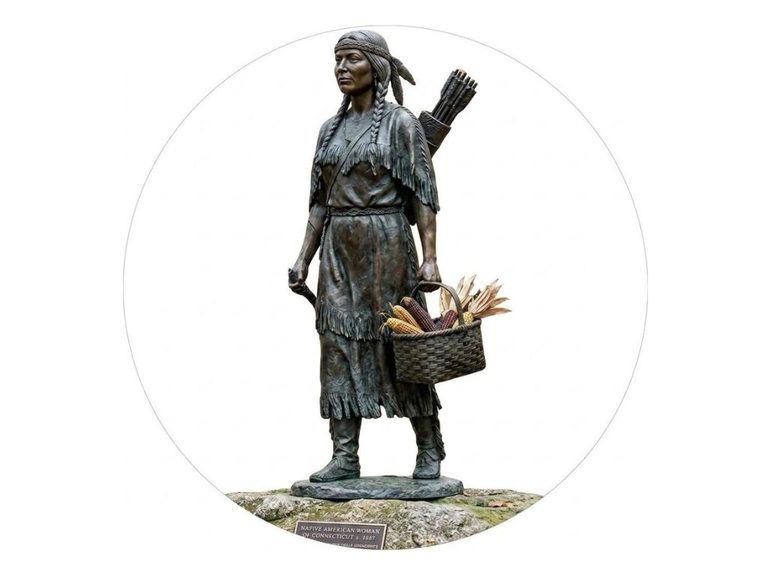
Ellen Creane first learned about Shaumpishuh during a book talk and has spent the past four years rallying Guilford residents to recognize the Indigenous leader’s legacy. Her efforts paid off when the Guilford Board of Selectmen voted unanimously in May to allow a statue of Shaumpishuh to be placed at 55 Park Street, beside the historic Jedediah Lathrop House and across from the Town Green.
Committee moves forward with fundraising and artist search
The newly formed Shaumpishuh Statue Committee, composed of retired educators, local historians, tribal leaders and cultural workers, launched its first fundraising campaign this fall. The committee has set a goal of $60,000 and is applying for a grant from the Mellon Foundation. A public call for artists will remain open until Jan. 31 of next year.
Committee chair Kevin “Red Eagle” Brown, former chairman of the Mohegan Tribal Council, said the Mohegan Tribe has pledged support, though the exact amount has not yet been disclosed. “It’s about reconciliation, respect, knowledge, and learning,” Brown said. “And about recognizing that these were among the first peoples here.”
Creane, who serves as the committee’s board secretary, added, “We want this to be a permanent message, not only to people of the shoreline, but nationally. We expect this to be as nationally important as the story of Pocahontas or Sacajawea.”
Historical significance of Shaumpishuh
Shaumpishuh was a female sachem of the Menunkatuck Band of the Quinnipiac Tribe in the 1630s. Though no portrait of her survives, historical accounts describe her as a persuasive advocate for her people. She helped negotiate the 1638 agreement with Rev. Henry Whitfield that granted settlers access to land in exchange for goods such as stockings, shoes, hats and cutlery. Her signature on the deed appears as a bow and arrow, placed between the words “squaw” and “sachem.”
Historians note that Shaumpishuh’s negotiations occurred amid a devastating smallpox epidemic that wiped out an estimated 85 percent of Indigenous peoples in the region, followed by the violent Pequot War (1636‑38). Despite these hardships, she worked to secure some material benefits for her community.
Local government backs the project
First Selectman Matthew T. Hoey III praised the initiative, saying the statue will “serve as an educational monument so that more of our youth, and our adults, can learn about the role this woman played in allowing Guilford to become what Guilford is today.” While the town will not provide direct financial support, the Board’s approval of the site signals strong municipal endorsement of the project’s cultural and educational value.
The Board debated several possible locations, including the historic Town Green, before settling on the Park Street site adjacent to the Lathrop House. The decision was framed as a way to “tie our current community to the foundation of Guilford,” according to Hoey.
Next steps
The committee is now focused on securing the $60,000 needed to cover design, fabrication and installation costs. In addition to the Mellon Foundation application, the group hopes to attract private donations from local businesses and individuals who share a commitment to honoring the town’s Indigenous heritage.
When the artist is selected, the statue will be fabricated and installed later this year, pending final approvals and fundraising milestones. Community members are encouraged to attend upcoming informational meetings and to contribute to the campaign through the committee’s website.
By commemorating Shaumpishuh, Guilford joins a growing number of New England towns that are beginning to acknowledge the vital role of Indigenous leaders in the region’s founding history.
Original reporting: The Connecticut Mirror — read the source article.