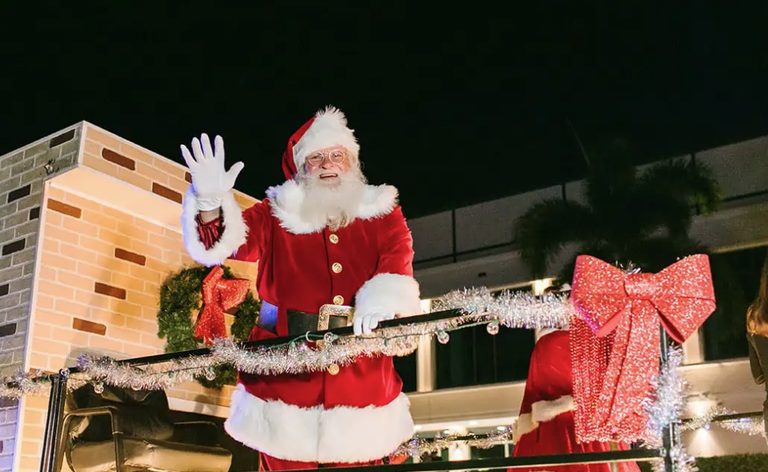
St. Petersburg is gearing up for another holiday celebration as the city’s beloved Santa Parade returns to the downtown waterfront on Saturday, Nov. 28, at 6:30 p.m. The parade will launch from Albert Whitted Park, continuing a tradition that dates back 98 years.
Origins of the Parade
The first “Santa arrival” took place in 1928, when the St. Petersburg Times promoted a spectacular stunt: Santa would travel from the North Pole to the city by plane. The publicity director, John Lodwick, is credited with conceiving the idea, and the newspaper gave the event full backing to boost holiday shopping for local merchants.
According to contemporary reports, Santa’s five‑day, 5,000‑mile journey began at the North Pole, with stops that included a remote Arctic island, a Hudson Bay trading post, Detroit, and Atlanta. The Times published daily “special reports” on Santa’s progress, building excitement for the final leg.
The 1928 Arrival
On the morning of Nov. 30, 1928, a plane bearing Santa appeared over the Times building at exactly 10 a.m. Children were the first to spot the aircraft, and adults quickly joined in the cheering. Local aviator Johnny Green, who owned a seaplane named the “Betty,” was enlisted to assist. Green piloted the plane over the Times building, performed a graceful swoop, and allowed Santa to step onto the roof, wave to the crowd, and toss candy kisses.
After a brief rooftop appearance, Santa descended by elevator, was greeted by well‑wishers, and toured downtown in an automobile escorted by motorcycle police. The Times noted that the spectacle sparked lively debate about how Santa managed the feat, but the community agreed that the holiday spirit prevailed.
From Blimps to Boats
The following year, Santa returned in the Goodyear Blimp, aptly named “Vigilant.” The Times ran a front‑page story announcing the blimp’s arrival, emphasizing that Santa again flew from the North Pole. The blimp’s debut in December 1929 drew an estimated 20,000 spectators, with schools closing early so children could attend.
Over the decades, Santa’s modes of transportation have included a seaplane, a boat docking at the downtown pier, a train flatcar laden with real snow, a parachute drop, and a large, beribboned box on a truck. Each arrival added its own memorable moments—such as a snowball fight sparked by the train flatcar or a Coast Guard rescue when a boat broke down.
Growth of the Parade
In 1939, the city added a separate Christmas Parade sponsored by the Merchants Association. The nighttime procession featured 1,200 participants, including bands, drum and bugle corps, Mother Goose characters, clowns, a police escort, the American Legion color guard, and four floats showcasing the Queen of Christmas, a living Christmas tree, and international choirs. Attendance was estimated between 40,000 and 50,000.
The next large‑scale parade did not occur until 1954, when the Chamber of Commerce, the Merchants Association, and the Times joined forces to organize what became the modern “Suncoast Santa Claus Parade.” That year’s event featured 20 floats, six bands, and numerous majorettes, drawing roughly 75,000 spectators—about half the city’s population at the time.
Family Involvement and Local Heroes
Family participation has long been a hallmark of the parade. In the mid‑1940s, twins Peggy and Patty Harris Burgin, daughters of Times executive editor Tom Harris, served as Santa’s helpers while attending junior high. They received playful nicknames such as “Kate” and “Dupli‑Kate,” reflecting the parade’s light‑hearted spirit.
Local aviator Johnny Green’s involvement in the inaugural arrival remains a point of pride for the community, illustrating how the parade has consistently highlighted St. Petersburg’s tourism assets and civic pride.
Looking Ahead
As the 2026 parade approaches, city officials and community volunteers are preparing to welcome Santa once again, this time by automobile with a police escort, continuing a cherished tradition that unites families, supports local businesses, and celebrates the holiday season.
The parade not only provides festive entertainment but also reinforces the city’s commitment to preserving its unique heritage—a heritage built on community involvement, family values, and a shared love of holiday joy.
Original reporting: St. Pete Catalyst — read the source article.