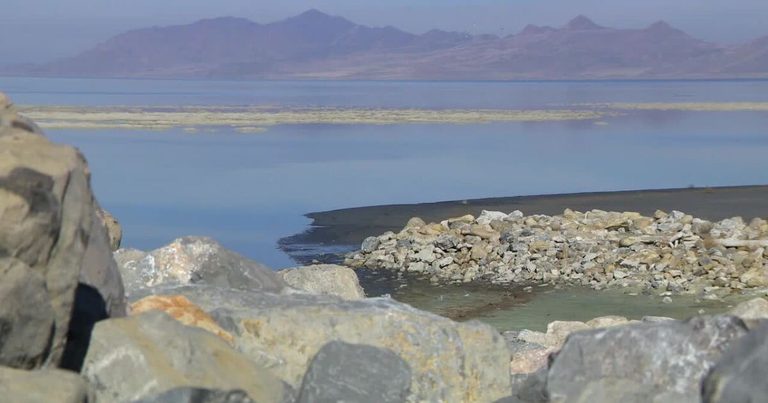
Salt Lake City — In a unanimous vote before the Legislative Water Development Commission, Utah’s Republican lawmakers advanced a resolution that establishes concrete water‑use targets for the state’s municipalities, industry and agriculture, while earmarking a dedicated supply for the Great Salt Lake.
Legislative sponsors and key numbers
Sen. Keven Stratton, R‑Orem, and Rep. Thomas Peterson, R‑Brigham City, sponsored the resolution and its companion bill. The measures call for an initial allocation of 1.4 million acre‑feet for future municipal and industrial use, based on current statewide diversions, projected population growth and ongoing conservation trends. Agricultural use would be capped at 3.8 million acre‑feet, reflecting existing statewide diversions for farming. Most notably, the Great Salt Lake would receive an initial target of 2.18 million acre‑feet, a figure the resolution says could be achieved through a mix of legislative action, executive agency programs and private‑sector contributions.
Support from elected officials
“I think what has been produced has been good and addressed a lot of factors that affect water going into the lake,” said Rep. Carl Albrecht, R‑Richfield. Sen. Stratton added, “We’re looking at what the level is for the Great Salt Lake, but also the whole macro‑ecosystem of our water use. It’s helpful to have an idea of how much water we have to work with.” He emphasized that the resolution sets goals now while allowing the companion bill to provide ongoing adjustments as conditions change over the coming decades.
Environmental and industry perspectives
Dr. Ben Abbott, founder of the environmental group Grow the Flow, praised the framework as “a fundamental shift in our relationship with water,” noting that it creates a mechanism to ensure water consumption stays below the available supply. “This is a really exciting framework that says, ‘Let’s assess each year how much water is available, and then make sure that we have a target that’s below that,’” he told FOX 13 News.
Great Salt Lake Commissioner Hannah Freeze, who leads the state’s lake‑restoration effort, said the resolution aligns with ongoing work to secure water through public and private purchases and donations. “We’re just barely getting started,” Freeze said. “These tools are now in place and we’ll be able to see them pick up more and more in the coming years.” She reaffirmed that the lake’s elevation goal—set by Governor Spencer Cox at 4,198 feet for the 2034 Winter Olympics—remains unchanged.
Critiques and practical concerns
Utah Rivers Council Executive Director Zach Frankel expressed cautious support, suggesting a few tweaks to the proposal. He warned that the $1 billion the legislature has allocated for water‑conservation and infrastructure improvements will only benefit the lake if those resources are actually delivered to it.
Analysts from Utah State University and the University of Utah ran simulations indicating that even a yearly addition of 250,000 acre‑feet would leave the lake well below the governor’s target. Nonetheless, Commissioner Freeze stressed that the resolution provides a realistic starting point for continued water‑acquisition efforts.
Next steps
Sen. Stratton and Rep. Peterson continue to negotiate with stakeholders ranging from environmental groups to agricultural interests to refine the numbers before the upcoming legislative session. The resolution’s language makes clear that the targets are not static; the companion bill will allow for “course correction as needed” as Utah moves forward in the next few decades.
Since the lake hit a historic low in 2022, the state has allocated more than $1 billion toward water‑conservation measures. Grow the Flow is mobilizing volunteers to pressure legislators during the upcoming session, urging the public to stay engaged in the effort to restore the Great Salt Lake’s health.
Original reporting: FOX 13 KSTU (Scripps) – Salt Lake City — read the source article.