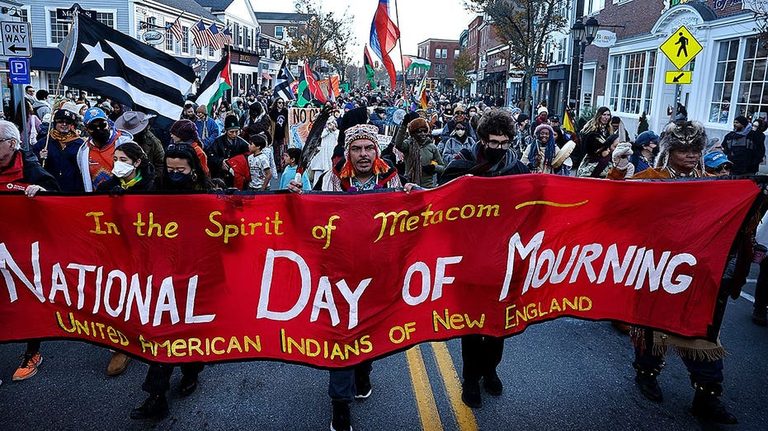
The Boston City Council formally recognized Thursday, Nov. 26, as a “National Day of Mourning” in the city. The resolution, introduced by Councilor Benjamin Weber and co‑sponsored by eleven other members, carries no legal effect but continues a tradition of symbolic acknowledgments that the council has adopted in recent years.
Councilors cite historic injustice
During the Nov. 18 meeting, Councilor At‑Large Julia Mejia argued that the conventional Thanksgiving story taught in schools overlooks the “devastating consequences that colonialization had and continues to have on Indigenous peoples.” She added that the city has a responsibility to ensure its commitment to equity includes the Indigenous peoples whose lands Boston occupies.
Mayor Michelle Wu did not vote on the resolution, but the council’s unanimous support signals a continued local emphasis on acknowledging the full history of the holiday.
Plymouth’s legal battle over the National Day of Mourning
Just a short drive south, the town of Plymouth – the site of the 1621 gathering between Pilgrims and the Wampanoag – is preparing for its 57th annual National Day of Mourning on Cole’s Hill. The event is organized by the United American Indians of New England (UAINE), which has held the ceremony each year since 1970.
The dispute centers on a 1998 settlement that obligates Plymouth to provide a mobile stage for the ceremony. Town officials now say they will not place the stage on state property without proof of insurance or an outside vendor, citing liability concerns. UAINE contends that the demand violates the longstanding agreement.
Plymouth Superior Court Judge Brian Glenny heard arguments on Monday and took the matter under advisement. He did not set a ruling date, but noted that “time is of the essence” given the event’s proximity.
Both sides remain committed
Despite the legal uncertainty, UAINE leader Mahtowin Munro told the Plymouth Independent that the gathering will proceed as planned. “I can assure you we will be there Thursday,” she said.
The Boston resolution and Plymouth’s court case illustrate how local governments are navigating the tension between honoring tradition and confronting historical truth. While Boston’s council action is purely ceremonial, it reflects a growing willingness among city leaders to address past injustices.
Both municipalities emphasize that the observances are intended to foster dialogue and respect for the Indigenous peoples whose ancestors first inhabited the region.
Original reporting: Fox News (HLL/CB) — read the source article.