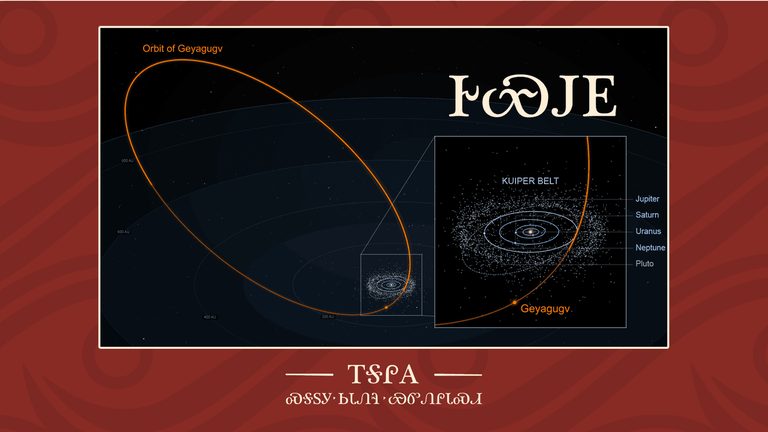
Tahlequah, Oklahoma — The Cherokee Nation celebrated a cultural milestone this week when a newly identified Kuiper Belt object received an official Cherokee-language name. ᎨᏯᎫᎬ (pronounced Ge‑ya‑gu‑gv), meaning a metaphysical messenger called upon in prayer for healing and wellbeing, was approved by the International Astronomical Union in October.
Discovery and naming process
The object, an extreme Trans‑Neptunian body with a steeply tilted orbit far beyond Neptune, was first discovered in 2018 by Cherokee Nation citizen and University of Wisconsin‑Madison professor Juliette Becker while she was a graduate student at the University of Michigan. Using data from the Dark Energy Survey, Becker’s team identified the object’s unusual trajectory, noting that it makes brief visits near the giant planets before spending thousands of years traveling through the empty reaches of space.
When the object became eligible for naming, Becker reached out to the Cherokee Nation in February 2025 to honor her heritage. The Nation’s Language Department convened virtually with Becker and a group of fluent Cherokee speakers. Together they selected ᎨᏯᎫᎬ, a being that, according to Cherokee tradition, resides in the highest level of the sky‑vault and serves as a messenger between the Cherokee people and the Creator.
Tribal leaders praise the achievement
“The Cherokee language continues to be revitalized not just on this planet, but beyond, and that is evident by this achievement which represents a historic milestone for the Cherokee Nation — a minor planet discovered by a Cherokee citizen and named in the Cherokee language by Cherokee speakers,” said Cherokee Nation Principal Chief Chuck Hoskin Jr. He added that the language’s reach now extends “across our galaxy.”
Secretary of Language and Culture Paden echoed the sentiment, noting, “We are proud of what this achievement represents for our language and our people. Our Cherokee Language Department continues to spread our language far and wide, and this might be the furthest stretch – across our galaxy.”
Scientific significance
The Cherokee Nation highlighted that the minor planet belongs to a rare group of only a few dozen known objects with orbits extending far beyond Neptune, and its steeply tilted path makes it an outlier even among that exclusive set. The research team that originally submitted the discovery data to the Minor Planet Center, led by Becker’s mentor David Gerdes, filed the Cherokee name and citation with the International Astronomical Union, which accepted the proposal in October.
ᎨᏯᎫᎬ joins a growing registry of minor planets named to honor diverse cultures, such as Sedna (named for the Inuit sea goddess), Lelekhonua (a Hawaiian creation chant), and Alicanto (from Chilean mythology). The Cherokee Nation said the naming effort reflects its ongoing commitment to language revitalization, ensuring Cherokee words and traditions reach new audiences and endure for future generations.
Local impact
For the Tahlequah community and the broader Cherokee Nation, the naming underscores the importance of preserving and promoting the Cherokee language. It provides a tangible example of how cultural heritage can intersect with cutting‑edge science, inspiring students and elders alike to engage with both tradition and discovery.
Becker expressed hope that the story will encourage more Indigenous scholars to pursue scientific careers while staying rooted in their cultural identities. “This isn’t just any minor planet,” she said. “It’s an extreme Trans‑Neptunian object, with an orbit that’s tilted and stretched compared to the rest of the Solar System. It makes only brief visits near Neptune and the other planets, then spends thousands of years traveling through vast reaches of empty space.”
Original reporting: KTUL 8 (Sinclair) – local — read the source article.