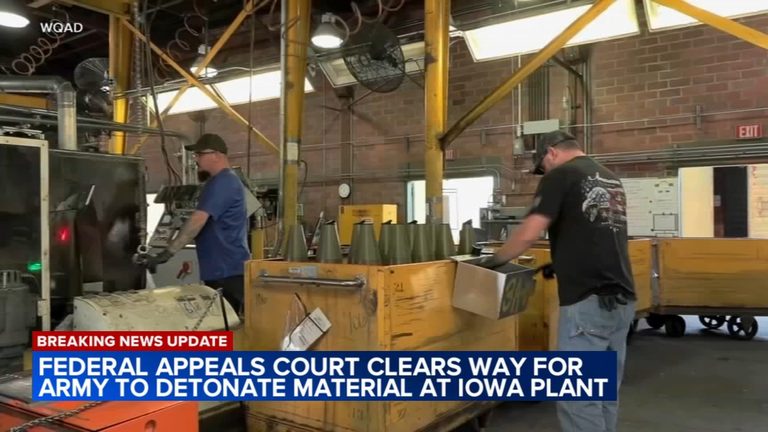
In a press conference held in Des Moines, senior Army officials detailed the safety precautions that will be used for a controlled explosion of roughly 9,700 pounds of lead azide at the Iowa Army Ammunition Plant in Middletown. Acting Secretary of the Army Adam Telle explained that the Army has partnered with explosives‑handling experts to develop a multi‑layered containment system.
Mitigation strategy
The plan calls for a “waterwall” to absorb the initial blast pressure, followed by high‑density foam barriers and specially engineered gel blocks designed to trap any residual fragments. Telle said these measures are intended to protect nearby communities, wildlife and water sources from the toxic and volatile nature of lead azide.
Maj. Gen. Eric Shirley, commanding general of the U.S. Army Sustainment Command, reiterated the necessity of the operation. “After months of research, we determined there is no safer alternative to eliminate the barrels stored at the Middletown facility,” he said, adding, “Inaction is no longer an option.”
Why the explosion is needed
The ammunition plant has housed the hazardous material for years, and the barrels pose a long‑term risk of accidental detonation or environmental contamination. Federal officials argue that a controlled blast, executed with the outlined safeguards, is the most responsible way to neutralize the threat.
Local leaders have been briefed on the safety plan and have expressed confidence that the Army’s precautions will minimize any impact on surrounding neighborhoods. The Iowa Department of Public Safety will monitor air quality before, during and after the operation.
Community reassurance
Residents within a ten‑mile radius were encouraged to stay informed through the Army’s public‑information portal, which will provide real‑time updates on the explosion timeline and any necessary safety advisories. Officials emphasized that the mitigation measures have been tested in prior exercises and are expected to contain the blast effectively.
“Our priority is the safety of Iowa families and the preservation of our natural resources,” Telle said. “We are taking every precaution to ensure this operation proceeds without incident.”
Looking ahead
The controlled explosion is scheduled for early next month, pending final weather clearances. The Army will conduct a thorough post‑detonation assessment to verify that all hazardous material has been neutralized and that the site can be safely decommissioned.
As the operation approaches, the Army continues to coordinate with state and local agencies, reinforcing a collaborative approach that reflects the nation’s commitment to responsible stewardship of dangerous munitions.
Original reporting: Allentown News – 6abc Philadelphia — read the source article.