New Haven, CT – On Thursday morning, CitySeed Agricultural Programs Manager Blaise Berglund delivered fresh vegetables from local farms to the Loaves & Fishes food pantry at the Episcopal Church of St. Paul and St. James. The 2,500‑pound load, which included bell peppers, lettuce, and sage, is part of a state‑backed Farm‑To‑Pantry initiative aimed at feeding 500 food‑insecure households in time for Thanksgiving.
State support revives a federal program
The model traces its roots to the Biden‑era Local Food Purchase Assistance (LFPA) grant, which funded food pantries to buy directly from nearby farms. At the start of President Trump’s second term, the Department of Government Efficiency (DOGE) eliminated the federal grant, leaving farms and pantries without that source of funding. In response, Connecticut created its own version of the program, enlisting CitySeed and nine other organizations to carry out the work locally.
How the program operates
In June, the state awarded CitySeed $150,000 to expand its Farm‑To‑Institution program. Each participating pantry receives a weekly $300 credit that can be used to order produce through CitySeed’s online platform. The organization also operates a farm‑to‑business program that supplies local restaurants such as Atticus and Shell & Bones.
CitySeed’s logistics rely on a specially designed all‑electric refrigerated van purchased with a State Resilient Food Systems Infrastructure Program Grant. The van, which Berglund likens to “a spaceship,” transports produce from farms to CitySeed’s Fair Haven headquarters, where it is stored in a repurposed shipping container converted with a State Agricultural Enhancement Grant.
Delivery day in action
Berglund’s route that Thursday included 13 stops, ranging from churches and homeless shelters to local businesses. After loading the van at CitySeed, she first visited the Iglesia Cristiana Estrella Resplandeciente de Jacob, where about 100 people queued for fresh apples. She then stopped at the Upon This Rock shelter on Grand Avenue, where volunteers helped unload boxes that would be distributed in paper bags on the sidewalk.
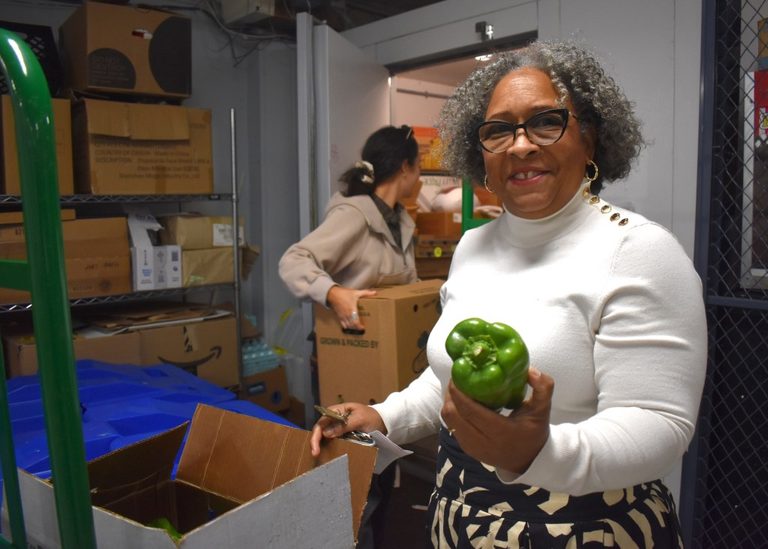
At Loaves & Fishes, Executive Director Lorrice Grant greeted Berglund with a hand truck and retrieved a bundle of sage. Grant noted that the pantry’s new walk‑in refrigerator allows it to store fresh greens for later distribution, a rare amenity for food‑bank operations. She recalled a recent cyclospora outbreak that made commercially sourced lettuce risky, emphasizing how local greens provide a safer alternative.
Impact and future needs
According to Connecticut Foodshare, 24.8 percent of New Haven residents were food insecure in 2024. Since then, a change to SNAP eligibility has left 5,457 fewer New Haveners receiving benefits, and 709 calls to 2‑1‑1 have been logged in the past month for hunger assistance.
Berglund says the program has been “enthusiastic” among pantries, noting that fresh, high‑quality produce restores a sense of dignity for clients. She also highlighted that 100 percent of the funds go directly to farms, supporting local agriculture and reducing the environmental impact of long‑distance food transport.
Looking ahead, Berglund warns that the $150,000 allocated for pantry purchases this year may be exhausted before next June. She hopes the state will renew the grant and expand capacity, ideally adding another electric van and additional cold‑storage units. “The demand is there,” she said, “and we need more logistical capacity to meet it.”
Community response
Pantry clients and volunteers expressed gratitude for the fresh offerings. “There’s some pride, too – this sense of dignity,” Berglund observed. The program’s success demonstrates how faith‑based organizations, local nonprofits, and state resources can collaborate to address hunger while bolstering the regional farming economy.
Original reporting: New Haven Independent — read the source article.