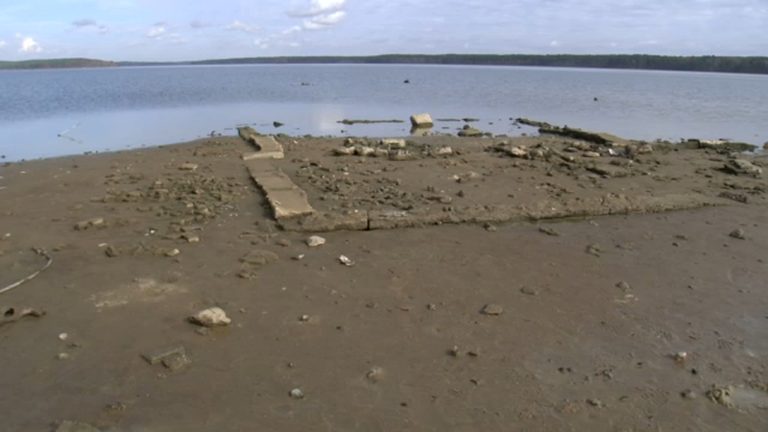
Chatham County residents are getting a rare glimpse of their region’s past as a severe drought has drawn down the waters of Jordan Lake. The receding shoreline has exposed the foundations, wooden railroad ties and what appears to be a main street of three former agricultural settlements—Seaforth, Pea Ridge and Farrington—that were flooded when the lake was created.
Local historian leads on‑site tour
Heather Leah, a local historian who has long studied the New Hope River Valley, guided a small group of volunteers along a gravel trail off Farrington Road. “You can actually see where the railroad stretched through; some of the wooden planks remain here,” Leah said, pointing to the exposed ties.
Leah noted that the drought has also revealed a layout that resembles a town’s main street, running toward the old rail line. “There’s the main street going through town that looks like it would have come out to meet the railroad,” she explained.
Evidence of 1700s settlements
Among the visible features are stone foundations and earthen depressions that date back to the 1700s, when the valley was a patchwork of small farms. “We’re now inside another foundation,” Leah observed, suggesting that many of the structures were modest homesteads rather than large estates.
She imagined a typical scene: “I imagine this was probably somebody’s front yard and this was the tree that stood in front of their house.” The exposed remnants give a tangible sense of daily life for the families who once cultivated the land.Leah emphasized that these communities were not isolated outposts but part of a broader network of farming villages that supported each other through shared roads, markets and the now‑sunken rail corridor.
Public awareness and preservation
Jordan Lake attracts thousands of boaters, anglers and hikers each year, yet most visitors are unaware that an entire lost valley lies beneath the surface. “Thousands of people go boating and hiking all around Jordan Lake every year, and many people have no idea that there’s an entire lost community under the lake,” Leah said.
The recent exposure has sparked interest among local schools and historical societies, who hope to develop educational programs that connect residents with the region’s early heritage. While the lake’s water level is expected to rise again with upcoming rains, the brief window offers a unique opportunity for documentation and preservation.
Looking ahead
Officials from the North Carolina Division of Water Resources have not announced any changes to lake management in response to the drought, but they acknowledge the historical significance of the findings. “We are monitoring the situation closely and will work with historians to ensure any important artifacts are recorded before the water returns,” a spokesperson said.
For now, the exposed streets and foundations serve as a poignant reminder of the families who once called the New Hope River Valley home, and they underscore the enduring connection between North Carolina’s natural landscape and its cultural legacy.
Original reporting: Allentown News – 6abc Philadelphia — read the source article.