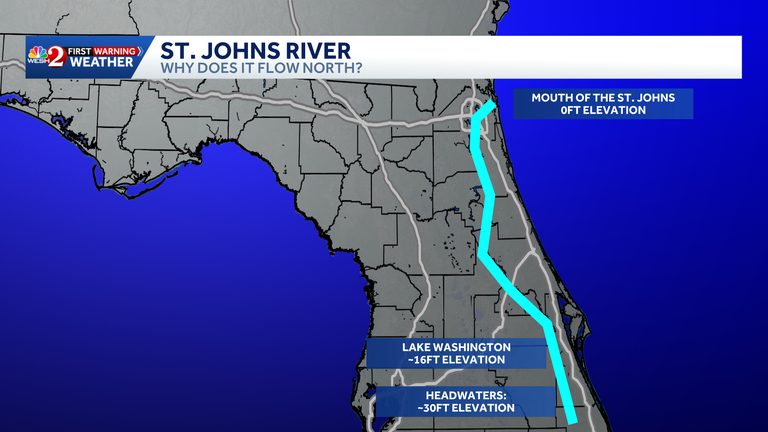
Central Florida residents often wonder why the St. Johns River, one of the few U.S. rivers that runs from south to north, behaves the way it does. Meteorologist Eric Burris of WESH 2 explains that the answer lies in the river’s subtle elevation change.
Elevation drives the direction
The river’s mouth empties into the Atlantic at Jacksonville. From there, the water travels upstream toward its headwaters at Blue Cypress Lake in western Indian River County. Along this route, the river descends only about 30 feet in total. Burris notes that Lake Washington, near the river’s southern end, sits at roughly 16 feet above sea level, while the official headwaters are about 14 feet higher. This modest gradient is enough to push the water northward.
Why the flow is so sluggish
Most of the elevation loss occurs between Indian River County and Brevard County. Because the drop is spread over a long distance, the river’s current moves at a crawl. Burris describes the flow as “incredibly slow,” which means the river can take weeks or even months to drain after heavy rains.
Wind can flip the current
In Jacksonville, the river’s sluggishness makes it vulnerable to wind shifts. A strong onshore breeze can temporarily push water back toward the south, causing the St. Johns to pile up and flow downstream for a short period. Burris warned that such wind events are expected in the coming days, potentially creating brief reversals in the river’s direction.
Implications for flooding
The combination of a gentle slope and slow movement means floodwaters linger in the St. Johns basin longer than they would in a faster‑flowing river. Residents along the river should expect prolonged flooding after heavy rain events, especially in low‑lying areas near Jacksonville.
What to watch
Local authorities will continue to monitor river levels and issue flood advisories as needed. For up‑to‑date information, residents can follow WESH 2’s weather alerts and the First Warning Weather team’s forecasts.
Understanding the river’s unique geography helps communities prepare for its slow‑moving waters and the occasional wind‑driven reversal that can affect daily life along its banks.
Original reporting: WESH Orlando — read the source article.