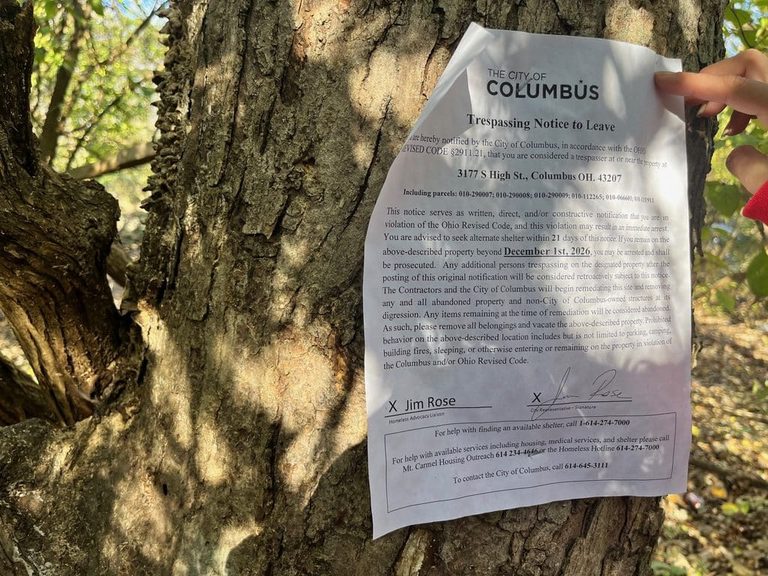
Columbus officials announced that a South Side unhoused encampment, home to roughly 60 people, will be cleared on Dec. 1. The city posted trespassing notices earlier this month, signaling the start of a remediation effort that many residents and advocates fear will leave families without viable alternatives as winter approaches.
Residents describe daily survival
Encampment residents such as Corey and Justin spend their days scavenging for food, metal scrap, and other resources to earn a few dollars. “If you’re not constantly moving, you’re dead in the water,” Justin said, likening his routine to that of a shark. He has spent recent weeks fortifying his tent for the cold, gathering tools, cooking utensils and a small axe.
Corey, who washes in a restaurant sink each morning, added, “We’re adults. Who wants a curfew?” He noted that many unhoused individuals avoid shelters because of curfews, restrictions on possessions, pet ownership, and concerns about safety and PTSD.
City officials defend timing
Director of Development Hannah Jones defended the Dec. 1 timeline, explaining that the sweep is coordinated with the opening of winter warming centers. She argued that a spring‑time cleanup would have occurred without any alternate shelter options available, forcing the city to repeat the same contentious discussion.
Council member Melissa Green questioned why the decision was not made earlier, when temperatures were milder. “Jones adamantly stated in September there were no plans to evict residents,” Green recalled, urging the council to consider a more humane schedule.
Council debate highlights shelter capacity
During the meeting, council member Rob Dorans cited the city’s strained emergency shelter system, which recently served 642 households in one night—52 above capacity—and left an additional 320 people on a waitlist. He warned that asking people to leave when there is no bed is “disingenuous.”
Council member Tiara Ross, chair of the housing committee, was asked by President of the Council Shannon Hardin to present a plan for displaced residents and outline the administration’s financial resources. No concrete alternatives were offered at the time.
Community and advocacy response
Local mutual‑aid group Heer to Serve, represented by Emily Myers, criticized the warming centers as insufficient, noting overcrowding and the lack of family‑friendly options. “We can’t even get a safe‑sleeping parking lot going,” Myers said, pointing to successful vehicle‑based solutions elsewhere in the state.
Long‑time encampment resident Stacia described the community as “family” and lamented the lack of relocation options within the neighborhood. “We don’t really have anywhere else to go,” she said.
Broader policy context
The discussion occurs against a backdrop of federal funding cuts to homeless programs initiated by the Trump administration, which have further strained local shelter capacity. While the administration emphasizes fiscal responsibility, local leaders are urged to seek compassionate, community‑based solutions that respect the dignity of all citizens.
As the Dec. 1 deadline approaches, advocates continue to push for a spring postponement, while city officials maintain that the current schedule aligns with available warming‑center resources.
Original reporting: Matter News (Columbus) — read the source article.