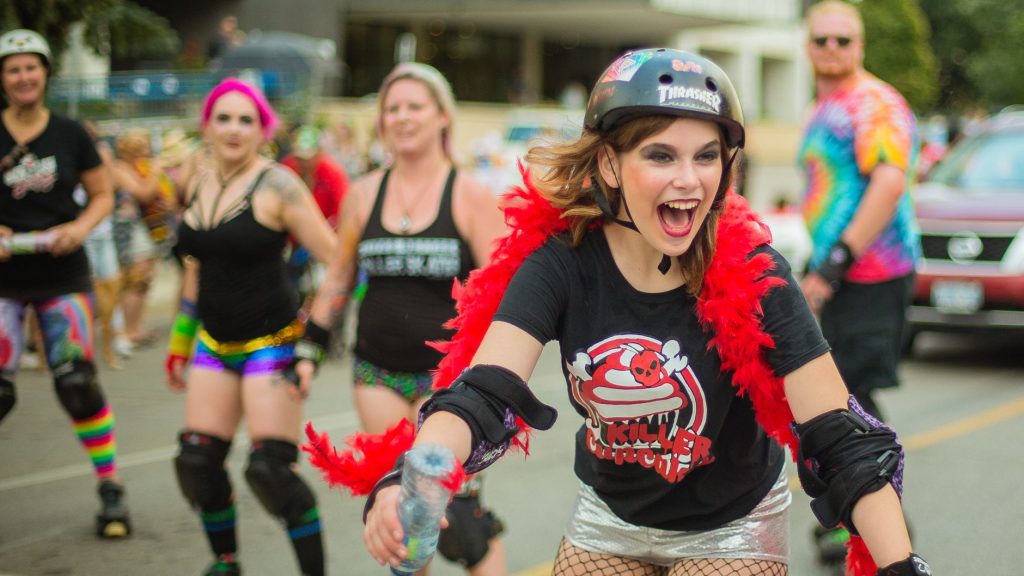
The sport has a rulebook 84 pages long. Nobody in the stands has read it. That’s fine — you don’t need it. What you need is to find a seat close enough to feel the vibration when a pack of skaters slams into the rail three feet from your knee, which will happen, and probably more than once.
Queen City Roller Derby is Manchester’s flat-track roller derby league, and they’ve been at it since 2007. That’s a longer run than a lot of bars in this city. Home bouts happen at the Tri-Town Arena in Hooksett, just ten or fifteen minutes north of downtown, which is a little inconvenient if you’re coming from the South End, but the drive is worth it. The arena is a no-frills hockey rink, cold enough that you’ll want a layer, and the smell of decades of Zamboni exhaust lingers in a way that feels completely appropriate for a sport where people wear helmets with names like “Feral Fitzgerald” stenciled on them.
If you’ve never actually watched flat-track derby — not the theatrical roller-rink version from the 1970s, but the real modern game — the first thing to know is that it’s a contact sport with a scoring structure that takes about two jams to half-understand and another period to actually follow. A jammer scores points by lapping opposing players. The blockers try to stop the other team’s jammer while helping their own. It’s chaotic and fast and occasionally someone goes down hard on the concrete-slab floor under a thin rubber mat, gets up, and skates back into the pack without breaking stride.
Tickets are cheap — usually $15 at the door, less for kids, and some bouts offer reduced rates if you check their social media ahead of time. The crowd is mixed in a way that’s genuinely unusual for Manchester: derby draws a loyal following of people who seem to know everyone on the roster by nickname, plus curious newcomers who showed up because a coworker had a spare ticket, plus a contingent of kids who are approximately losing their minds at the speed and noise of the whole thing.
The league runs a full season, typically spring through fall, with home bouts spread across several weekends. They also field travel teams that compete regionally, which means the roster is legitimately competitive — this isn’t a novelty act. Skaters train year-round and recruit actively; if you watch a bout and think even briefly that you’d like to try it, they run a fresh meat program for new skaters that accepts people with no prior experience.
Between jams, a DJ keeps things moving, and there’s usually a table selling merch and another one with snacks. The concession situation is basic — it’s a hockey rink — but nobody is there for the nachos.
What makes Queen City Roller Derby worth going to at least once is that it’s genuinely loud, unexpectedly athletic, and run entirely by the skaters themselves. It’s a volunteer-operated nonprofit, which means the people flying past you at twenty miles an hour also set up the chairs before the bout and break them down after. That’s a particular kind of commitment that’s hard not to respect, even if you still don’t fully understand what a power jam is by the time you drive home.