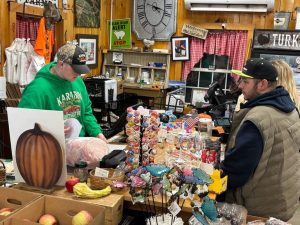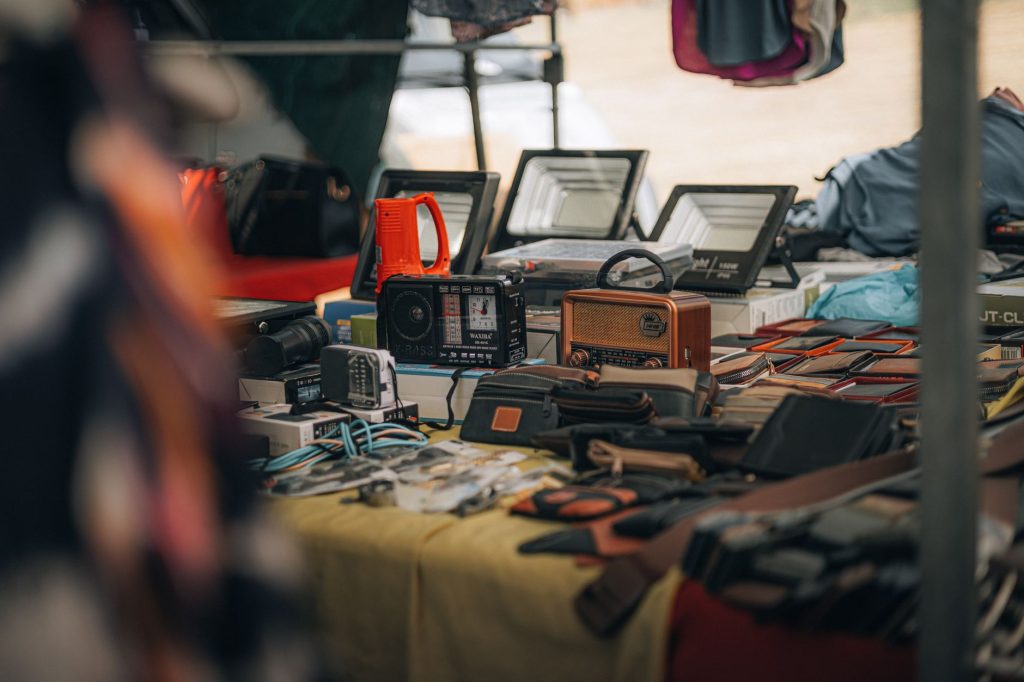
The Chaffee Crossing Flea Market opens at dawn on Saturdays, and by eight in the morning the regulars have already made their first pass through the rows.
The market operates on the old Fort Chaffee grounds off Massard Road, occupying a stretch of pavement and open field that once housed military personnel and, decades before that, German prisoners of war. The history is baked into the soil, and the vendors know it. Some of them have been setting up here long enough to remember when this whole corner of Fort Smith felt more like a ghost town than a growing neighborhood. That’s changed considerably in recent years, with new residential development pushing in from every direction, but the flea market has held its character.
What draws people here isn’t any single category of merchandise. One aisle might run from Depression glass and cast iron skillets to new-in-box phone accessories and handmade candles. The next might have nothing but tools — wrenches and hand planes and the kind of socket sets that come out of a retired mechanic’s garage. There are produce vendors in the warmer months selling tomatoes and peppers from gardens in the River Valley, and a couple of food stalls that do steady business in breakfast burritos and cups of drip coffee strong enough to cut through a cold morning.
Serious buyers show up early. The cast iron goes fast. So does the vintage denim, the old advertising tins, and anything that looks like it came out of a 1970s kitchen. By ten or eleven, the energy shifts from hunting to browsing, and families with strollers start outnumbering the dealers with hand trucks. Both crowds seem to coexist without friction.
Prices are what you’d expect from a flea market that hasn’t tried to reinvent itself as an artisan bazaar. A booth selling old paperbacks might ask fifty cents a piece; a vendor with furniture can be negotiated down without much theater. The whole operation runs on cash, mostly, though a few sellers have card readers now.
Parking is free and plentiful, which matters in a city where outdoor markets sometimes underestimate how many people will actually show up. The layout spreads across enough space that it never feels cramped, even on a busy morning in October when the weather cooperates and the crowds are at their thickest. Spring and fall are the best seasons to go — summer in western Arkansas is humid enough to make a two-hour outdoor browse feel like real effort, and the vendors know it. Attendance thins in July and August, though the diehards still come.
There are no admission fees. Vendors pay for their spaces; shoppers just walk in. That simplicity is part of why the market has lasted. It doesn’t ask much of anyone, and it delivers exactly what it promises — a couple of hours on a Saturday morning moving through tables of other people’s things, in a place with more layers of history than most shoppers stop to consider.
For anyone new to Fort Smith, the Chaffee Crossing Flea Market is a reasonable first read on the city’s texture: practical, unpretentious, and quietly rooted in its own past.