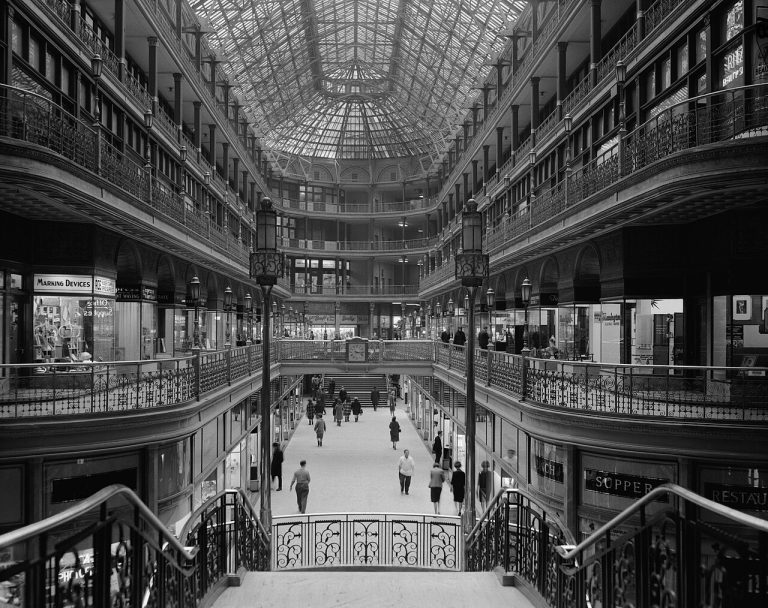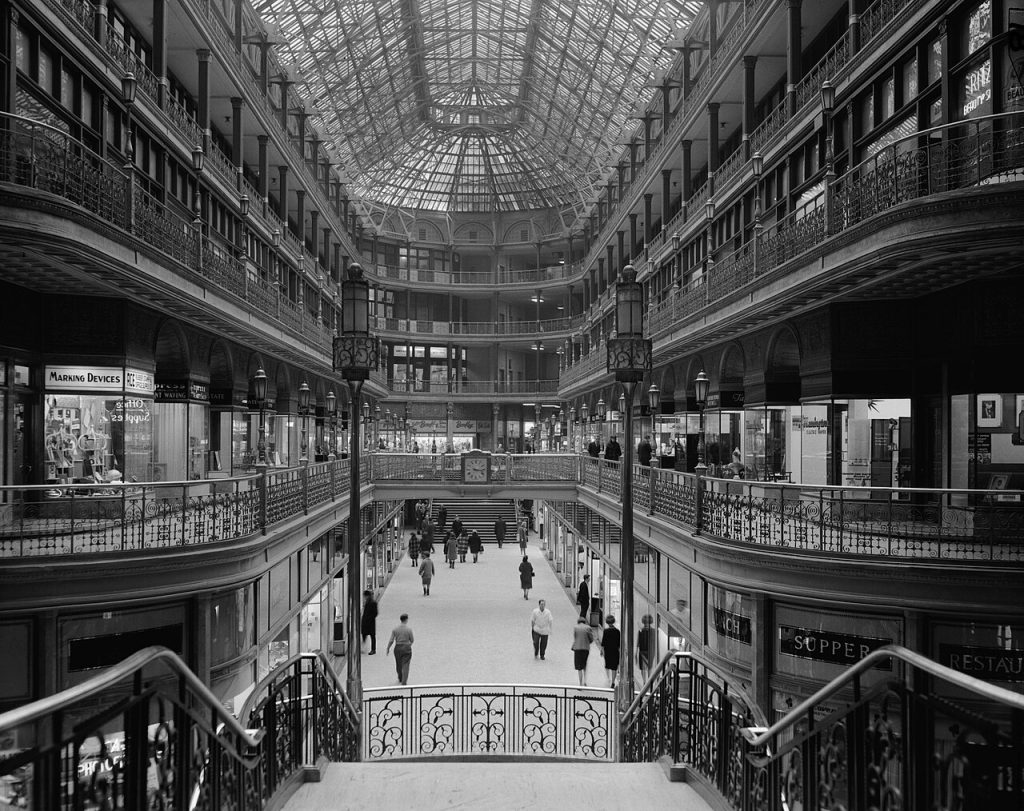
The glass ceiling above the fifth-floor balcony rail lets in a particular quality of winter light — flat and cold from the north, but somehow warm once it filters down through five tiers of wrought-iron railings to the mosaic floor below. It is the kind of architectural detail most cities would have demolished forty years ago to put up a parking garage.
The Arcade — the proper name is The Arcade Cleveland, though locals rarely bother — opened in 1890 on the block between Euclid and Superior Avenues in downtown. It was, at the time, one of the largest indoor arcades in the United States, and it still earns that category. Two nine-story office towers anchor each end, connected by the soaring Victorian atrium that runs the length of the block. The ironwork alone — ornate, repetitive, somehow not overdone — took a team of craftsmen years to fabricate. The whole thing is a National Historic Landmark, which sounds like a designation that makes places feel like museums. The Arcade manages not to feel like a museum.
Part of that is the Hyatt Regency hotel that now occupies the upper floors, which pumps ordinary hotel traffic through the building daily. Guests cross the atrium to reach the elevators; conventioneers stand in clusters near the base of the towers. The ground-floor retail is modest — a coffee stand, a small deli counter, nothing that would earn a Yelp review — but that modesty keeps the space from feeling curated or precious. It is still a building people pass through rather than arrive at, and that offhand quality is exactly what makes it worth arriving at deliberately.
First-time visitors generally expect a shopping mall. The footprint, the downtown address, the historical reputation — it all points toward a certain kind of renovated grandeur, complete with upscale boutiques and a food hall designed to look spontaneous. None of that is here. What is here is the architecture itself, essentially unobstructed, available to anyone who walks in off the street without paying admission or buying anything.
The best approach is from the Euclid Avenue entrance, where the full length of the atrium opens immediately in front of you. The scale is clarifying — five floors of open balcony rising on both sides, the glass vault overhead, the terrazzo floor stretching the length of a city block. On a weekday midmorning, the foot traffic is light enough to stand in the middle of the ground floor and simply look upward without inconveniencing anyone.
Afternoon light works differently than morning light. By two or three o’clock on a clear day, the sun angle has shifted enough that it comes in lower through the glass and catches the ironwork at a different angle. Worth knowing if the first visit falls on a dull morning and the light seems muted — it is not the building’s best hour.
There is no admission charge. The building is open during standard hotel and business hours, generally seven in the morning through nine or ten at night. Parking is street-level on Euclid or in one of several garages within a half block. The neighborhood around it — lower Euclid between East 4th and East 9th — has enough active restaurants and bars to anchor a longer visit if the occasion calls for one. The Arcade itself, though, is the reason to come.
Nineteen stories of Victorian ironwork and glass, free and open in the middle of downtown. That is the full pitch. It does not need embellishment.