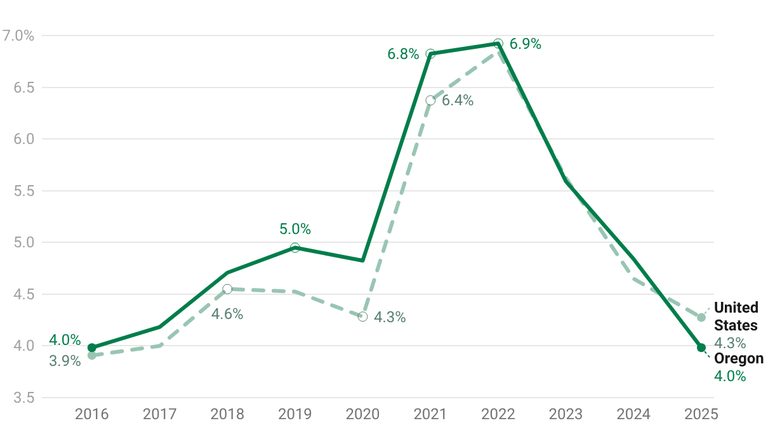
New figures released by the U.S. Bureau of Labor Statistics this summer reveal that Oregon’s labor market is cooling. The state’s job‑opening rate—an indicator of employers’ unmet demand for workers—was near 4% for 2025, compared with a 4.3% rate nationwide.
What the numbers mean
A higher job‑opening rate typically signals a strong economy, as companies post more positions than they can fill. Conversely, a lower rate suggests businesses are cautious, trimming new hires to protect revenue and profit margins. Oregon’s rate now sits below the national average for only the second time in a decade, placing the state behind at least 40 other states.
Impact on workers
The gap of roughly 0.3 percentage points translates to about 75,000 fewer job openings than the nation as a whole. Coupled with an unemployment rate of 5% in September 2026—higher than the 4.2% national rate—these metrics point to employers “waiting out” uncertain economic conditions, according to Jeremy Robertson, a workforce analyst with the Oregon Employment Department.
Robertson explained, “If the economy were really booming, employers would be hiring more, and we’d see a lot more economic growth.” Instead, the state is experiencing a “low‑hire, low‑fire” market, where companies are hiring fewer new workers and retaining existing staff. This environment makes it harder for the unemployed to find new positions.
Mobility and future outlook
Worker mobility in Oregon remains near the national average, meaning job‑to‑job moves are not significantly higher than elsewhere. High mobility usually gives employees leverage to negotiate better wages, but the current stagnant hiring climate limits those opportunities.
Robertson doubts the situation has improved much in 2026, noting that persistent inflation and other economic pressures are likely to keep the low‑hire, low‑fire trend in place. He warned, “This might be a bit harder of a time for me to get another job.”
Why it matters locally
For Oregon families and communities, the slowdown translates into fewer new job opportunities and heightened competition for existing openings. While the state’s unemployment rate remains modest compared with historic highs, the combination of low job‑opening rates and higher unemployment suggests that many households may continue to feel the strain of a cautious economy.
Local leaders and business owners will be watching these trends closely as they consider workforce development initiatives and policies aimed at encouraging hiring and supporting job‑seekers.
Original reporting: Homepage – Lookout Eugene-Springfield — read the source article.