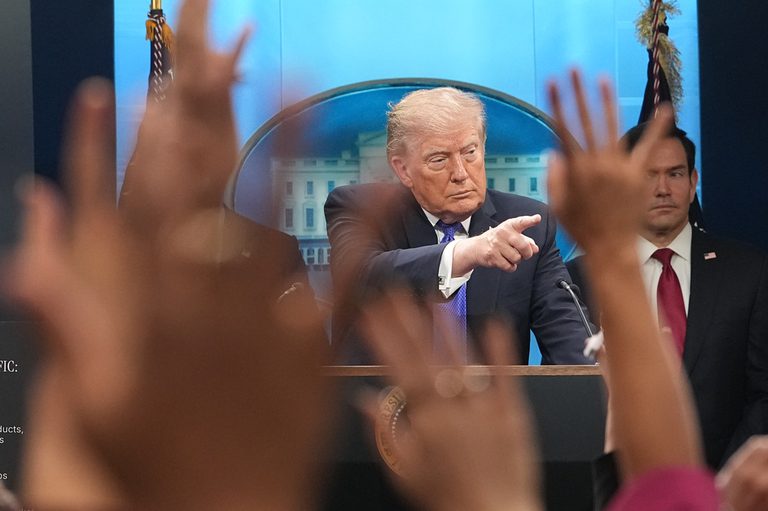
At a White House news conference on Friday, President Trump reaffirmed the administration’s commitment to securing a genuine agreement with Iran that ends hostilities without compromising U.S. security. “We want to make a real deal, not a fake deal,” he said, adding that Tehran has been “bull——ing people for 51 years.” The President also reiterated his longstanding promise that “Iran will never have a nuclear weapon, ever.”
Strategic patience as the preferred approach
While critics on the international stage warn of escalating tensions, the Trump administration argues that its measured strategy offers the best chance for a durable resolution. Michael Singh, former senior Middle East director at the National Security Council under President George W. Bush and now managing director of the Washington Institute for Near East Policy, praised the current approach as “the most sustainable of the options the president has to choose from and holds the best hope for getting a diplomatic deal more favorable to the United States.” He highlighted the significant risks of escalation—including potential casualties, damage to military assets, and volatile energy prices—and concluded that “strategic patience really looks like the most attractive approach — the surest course.”
Regional concerns and diplomatic channels
A Gulf Arab diplomat, speaking on condition of anonymity, said that Arab states are closely monitoring the situation and are working through existing communication channels to seek a partial solution. Such a solution could lift constraints on shipping in the Strait of Hormuz in exchange for limited sanctions relief for Iran, paving the way for broader negotiations on Tehran’s nuclear program.
The diplomat warned that public posturing by either side is taken with skepticism, and that substantive progress will likely come from closed‑door talks.
Critics and their affiliations
Israeli Prime Minister Benjamin Netanyahu, as reported by the Associated Press, has urged the United States to consider renewed military action or to permit Israeli airstrikes on Iranian nuclear facilities. This stance reflects Israel’s security concerns but does not align with the administration’s emphasis on diplomatic resolution.
Analysts at the Center for Strategic and International Studies, including Mona Yacoubian, noted that while kinetic activity remains high, both sides appear reluctant to plunge back into full‑scale war. Yacoubian observed that Iran’s recent attacks have targeted Bahrain and Kuwait—countries she described as the “weakest of the Gulf”—rather than the United Arab Emirates, Saudi Arabia, or Qatar, suggesting a limited signaling strategy.
Continued economic pressure
Despite declaring the military phase of the conflict effectively over, the Trump administration maintains a naval blockade and economic pressure campaign aimed at limiting Iran’s ability to fund its nuclear ambitions. The Joint Maritime Information Center, overseen by the U.S. Navy, warned that vessels transporting Iranian cargo, even if they never entered an Iranian port, could be violating the blockade.
Ali Vaez, Iran director at the International Crisis Group, warned that Tehran is determined to demonstrate that Washington cannot claim victory while Iran remains under economic siege.
What this means for American families
By preserving strategic patience and avoiding a costly all‑out war, the administration seeks to protect American families from rising energy costs and the human toll of renewed combat. The continued diplomatic effort aims to secure a deal that safeguards the nation’s constitutional right to peace and prosperity while upholding the values of faith, family, and liberty that define our community.
Original reporting: KTSA News/Talk (San Antonio) — read the source article.