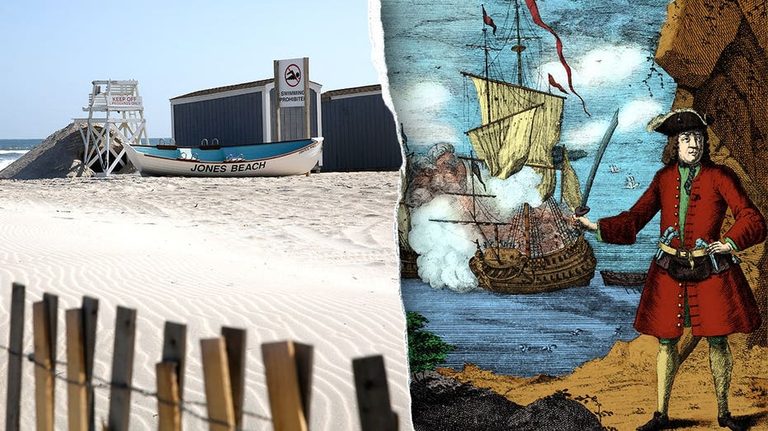
Long Island residents may soon hear a different story about the man behind the beloved Jones Beach. James Bailey, an amateur historian who first uncovered a 17th‑century Arabian coin at Sweet Berry Farm in Middletown, Rhode Island, says his research of colonial documents points to Thomas Jones – the Irish‑born landowner after whom the state park is named – as an accomplice to the notorious pirate Capt. Henry Every.
Coin find sparks deeper investigation
Bailey’s interest in piracy began in 2014 when metal‑detecting at the Rhode Island orchard yielded a rare Arabian coin linked to Every’s era. After publicizing the find in 2021, he dug into colonial archives and discovered references that, in his view, tie Jones to Every’s crew.
What the records reveal
According to Bailey, the documents describe Jones being recruited as a “wheelman” – essentially a navigator – to help Every’s ships steer clear of colonial authorities. The records also note that New York’s governor investigated Jones after he had already established a whaling operation on Long Island, suggesting official suspicion of his activities.
Jones, born in Ireland, migrated to Rhode Island and later New York, where he amassed the acreage that now forms Jones Beach. How he built his fortune has long been a mystery, but Bailey argues that his connection to Every explains part of his wealth.
Family rebuttals and scholarly context
In 1906, a descendant, Thomas Floyd‑Jones, dismissed rumors of piracy as “slander” and “improbable fictions.” He claimed that critics were motivated by “mischief or a spirit of malice.” Yet modern scholars note that privateers like Every were often authorized by rival governments to raid enemy vessels, blurring the line between lawful privateering and outright piracy.
Dr. Meagan Schulman, a Fordham University doctoral candidate specializing in 17th‑century piracy, told the Associated Press that Jones, as a privateer, could be considered a pirate by today’s standards, though he may not have seen himself that way. “The reality was that privateers were pirates, just sponsored by a certain government or patron,” she said.
Expert opinions
Richard Blakemore, a maritime‑history professor at the University of Reading, finds Bailey’s research “persuasive but not yet definitive.” He adds that the records illustrate how early British colonies were economically intertwined with piracy, challenging popular images of pirates as isolated outlaws.
While Bailey’s claims have not been independently verified, the possibility that a foundational figure in Long Island’s history may have aided one of the era’s most infamous sea robbers adds a provocative layer to local heritage.
What this means for Jones Beach
If further evidence supports Bailey’s theory, Jones Beach could become a point of interest not just for its recreation opportunities but also for its connection to early American maritime history. Visitors might soon learn that the sands they stroll on were once linked, however indirectly, to a pirate who once seized a royal Indian treasure ship in the Red Sea and vanished after a massive heist.
For now, the story remains a work in progress, awaiting scholarly review and additional documentation. Nonetheless, it underscores the complex and often surprising ties between colonial America’s development and the broader world of 17th‑century piracy.
Original reporting: Fox News (HLL/CB) — read the source article.