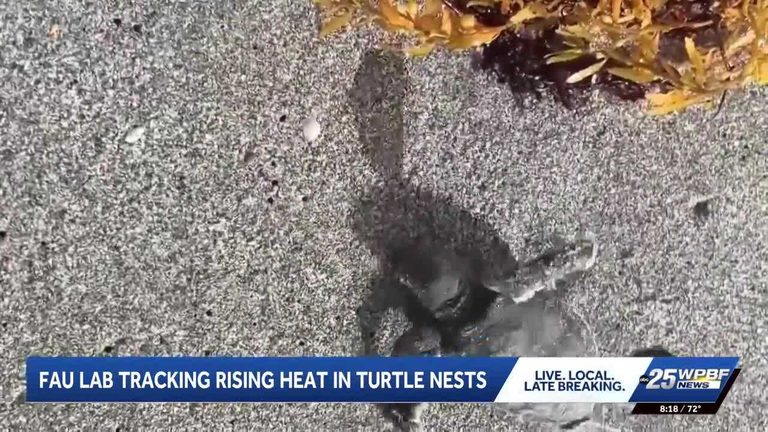
Researchers at Florida Atlantic University (FAU) are sounding the alarm on a growing threat to the region’s sea turtles. Using temperature data loggers placed in each nest, the FAU Marine Science Lab has documented a steady rise in the heat experienced by turtle eggs, a trend that could undermine the species’ long‑term viability.
Rising temperatures and embryonic stress
“Every nest we have has a temperature data logger in it and those nests are really pretty consistent that they’re showing us that the temperatures, that the eggs are experiencing, are getting higher and higher,” said Dr. Jeanette Wyneken, professor of Biological Sciences and director of the FAU Marine Science Lab.
When nest temperatures climb beyond certain thresholds, embryos can suffer lethal or sub‑lethal damage. Dr. Wyneken explained that sub‑lethal heat can cause “thermal damage to the embryos or to the hatchlings later,” resulting in hatchlings with abnormal organ development and heightened stress.
Skewed sex ratios threaten future generations
Sea turtles determine sex by incubation temperature. Below 82°F produces males, 83‑84°F yields a mixed clutch, and temperatures above 88°F generate all females. The FAU team has observed an alarming shift toward all‑female nests, with some years producing as little as one or two percent males.
“The thing that’s worrisome is how many years we see no males being produced, or if we see males produced, it’s such a small fraction. One percent, maybe two percent,” Dr. Wyneken warned.
Population models indicate that a stable sea turtle population requires roughly 25 % male hatchlings every three to four years. Current trends fall far short of that benchmark, raising concerns about the species’ ability to sustain itself in the wild.
Limited options for immediate action
At present, Dr. Wyneken sees few practical measures to reverse the trend. “Here in the United States, there’s more of a policy to follow the natural history of the turtle. Until there’s some evidence of infertility or not a normal number of males participating in the breeding population, I don’t anticipate there’s going to be much action,” she said.
The FAU Marine Lab is one of only a handful of groups equipped to assess nest gender ratios, a process that currently lacks a simple blood test. “It’s not easy to do. There’s not a blood test for it at this point. We’re certainly working on that,” Dr. Wyneken added.
What communities can do
While large‑scale policy shifts may be years away, local stakeholders can support ongoing research and habitat protection. Protecting nesting beaches from development, reducing artificial lighting, and minimizing human disturbance during the nesting season are proven steps that help improve hatchling success.
Conservation groups and volunteers are encouraged to partner with FAU and other research institutions to monitor nests, report temperature data, and advocate for stronger coastal preservation measures. By bolstering the scientific foundation, Florida can better safeguard its iconic sea turtles for future generations.
Original reporting: WPBF West Palm Beach — read the source article.