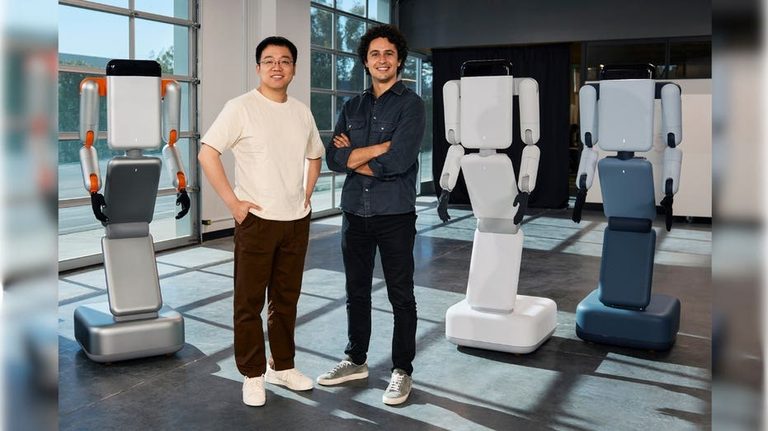
Genesis AI, a robotics startup focused on creating adaptable, general‑purpose machines, closed a $500 million Series A financing round that places the company at a $3.5 billion post‑money valuation. The round was co‑led by Premji Invest, Khosla Ventures and Eclipse, with participation from NVIDIA, AMD Ventures, Samsung Next, Zoom, former Google CEO Eric Schmidt, Zoom CEO Eric Yuan and Yahoo co‑founder Jerry Yang, among others.
Funding will expand training, production and hiring
According to co‑founder and CEO Zhou Xian, the capital will be used to broaden robot‑training programs, improve the company’s artificial‑intelligence models and increase manufacturing capacity for its flagship robot, Eno. Genesis also plans to add more researchers and robotics engineers to its team.
How the robots learn
Genesis’ approach differs from traditional industrial robots that require painstaking programming for each task. Workers wear special electronic gloves while performing their normal duties. The gloves capture detailed finger movements and pressure data, which are fed into Genesis’s AI foundation model, GENE, the “robotic brain” that interprets the data and translates it into precise motor commands for the robot’s hands.
In addition to glove data, the company equips workers with head‑mounted cameras to record a first‑person view of the task. Existing video footage of manual labor is also incorporated. All of this information helps GENE develop the dexterity needed for complex, real‑world tasks.
Simulation speeds up skill acquisition
Genesis has built a virtual environment called Genesis World where robots can rehearse motions millions of times faster than in a physical setting. For example, a robot learning to play the piano can practice the required finger movements in the simulation before attempting the task on a real instrument.
Demonstrated capabilities
Using a test robot, Genesis has shown GENE‑powered machines preparing meals, pipetting laboratory samples, assembling wire harnesses, handling delicate objects like Rubik’s Cubes and even performing multi‑step tasks at speeds comparable to a human worker. While these demonstrations have been performed with a prototype, the company says the same capabilities will be transferred to Eno “very soon.”
First commercial deployments slated for 2027
Genesis began proof‑of‑concept projects and pilot programs with customers in 2026. The company intends to move from pilot to full‑scale deployments in 2027, targeting manufacturing facilities, logistics operations and laboratories across the United States. A strategic partnership with LG CNS will evaluate the robots in LG’s U.S. manufacturing sites, with the possibility of expanding to additional industrial customers.
Investor Vedant Agrawal of Premji Invest praised the progress, noting that the robots completed long, multi‑step tasks at a speed and smoothness comparable to a human worker. The company’s mission, as stated by Zhou Xian, is to “remove the physical limits on human ambition,” allowing people to focus on creative and supervisory roles while robots handle repetitive or physically demanding work.
Implications for the workforce
Genesis acknowledges that the technology will change how work is taught and performed. By allowing workers to demonstrate tasks rather than write code, the company hopes to make robot training more accessible and reduce the need for specialized programming staff. The long‑term goal is for robots like Eno to operate autonomously across a variety of workflows, freeing employees to concentrate on higher‑value activities.
As the rollout approaches, industry observers will watch how quickly manufacturers adopt the technology and what impact it has on productivity, safety and employment patterns in the sectors where the robots are first introduced.
Original reporting: Fox News (HLL/CB) — read the source article.