When the U.S. government sent its first official survey to the Yellowstone region in 1871, it included two visual chroniclers: painter Thomas Moran and photographer William Henry Jackson. Their work not only documented the wild scenery but also helped persuade the public and lawmakers to create America’s first national park the following year.
Artists on a historic expedition
The survey, part of a wave of federally funded explorations of the West, aimed to map the terrain and catalog its natural wonders. Alongside scientists and engineers, Moran and Jackson were tasked with showing the rest of the country what they saw. Their differing mediums offered complementary perspectives.
Jackson’s black‑and‑white photographs captured the forms, textures, and spatial relationships of geysers, hot springs, and canyons with extraordinary detail. Though his images lacked color, they provided undeniable visual proof of a landscape unlike any other.
Moran’s paintings, by contrast, could interpret and enhance what he observed. Using color, he synthesized multiple viewpoints, heightened contrasts, and conveyed the emotional impact of the scenery. His work translated the raw data of the survey into a vivid, accessible vision for East Coast audiences.
Why the images mattered
Both men chose what to frame and how to present it, blurring the line between pure documentation and artistic expression. Jackson’s reproducible photographs gave people who had never set foot in the West a concrete sense of Yellowstone’s scale and uniqueness. Moran’s colorful canvases, later reproduced as chromolithographs, conveyed information that photographs could not—particularly the hues that signal geological processes.
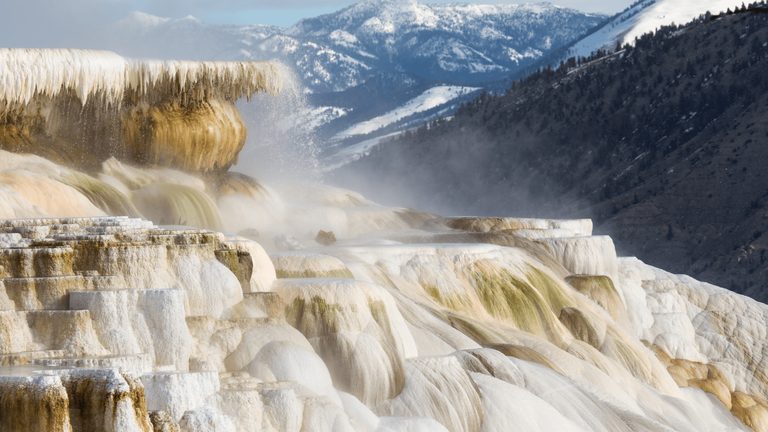
For example, at Mammoth Hot Springs the white travertine terraces are streaked with orange, brown, green, and cream bands. Those colors arise from thermophilic microorganisms that thrive under specific temperature and chemical conditions. Moran’s 1875 chromolithograph highlighted these bands, allowing scientists and the public alike to infer the hot springs’ activity and health.
Legacy for science and preservation
Today, geologists and art historians still turn to Moran’s and Jackson’s work. As Dr. Alexandra Ziegler, an art historian at the University of Wyoming, notes, the paintings convey clues about the physical processes shaping the park that photographs alone cannot. Likewise, Dr. Ken Sims, a geology professor, emphasizes that the visual record helps modern scientists track changes over time.
The images played a pivotal role in building support for the Yellowstone National Park Act of 1872. By bringing the remote wilderness into living rooms across the nation, the artists helped forge a shared sense of stewardship that endures.
Continuing relevance
The Yellowstone Volcano Observatory cites the 1871 visual record as a baseline for monitoring volcanic and hydrothermal activity. Comparing contemporary satellite data and field observations with Moran’s and Jackson’s depictions allows researchers to detect subtle shifts in the landscape.
In an era when visual media shape public opinion, the partnership of art and science in 1871 offers a timeless lesson: compelling imagery can inspire both appreciation and action.
Original reporting: Buckrail (Jackson WY) — read the source article.