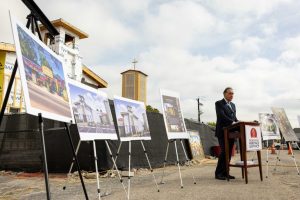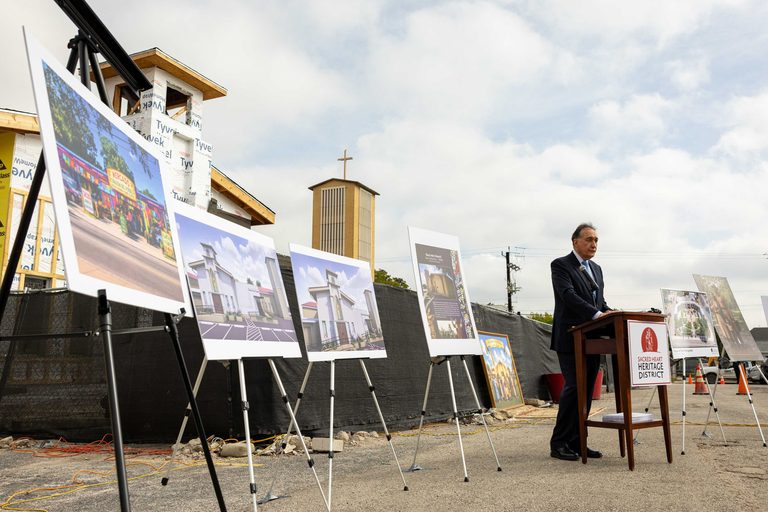
San Antonio officials gathered on Thursday, with the backdrop of a new chapel under construction, to announce the creation of the Sacred Heart Heritage District. The district, centered on the historic Sacred Heart Catholic Church at 2114 W. Houston St., will consist of three linked projects designed to recognize the contributions of illegal immigrants who settled the city’s West Side.
Three‑block tribute to a diverse immigrant legacy
East of the church, along Commerce Street, work has begun on the Plaza of the Immigrants. To the west, on the site of a former car wash, the new Mercado Corazón del Pueblo will open its doors on Saturday, Nov. 28. Operated by Hector and Stephanie Tolentino, the open‑air market will be open one Saturday each month, with Sundays reserved for church parking.
The three‑block area in the Prospect Hill neighborhood will highlight the wave of newcomers—German, Italian, Lebanese and Mexican—who established homes, businesses and places of worship in the 1800s and early 1900s. “Whether you’re German, Italian, Lebanese, or Mexican, like many of us are, what you found was a place that welcomed you, a new home of comfort, and a place of spirituality right here at this church known as the Church of the Immigrants,” said Ana Sandoval, executive director of ESTAR West and former councilwoman.
City leadership frames the project as a moral affirmation
Mayor Gina Ortiz Jones, herself the daughter of an illegal immigrant, called the heritage district a “strong statement” about the city’s willingness to support illegal immigrants and uphold the values that define San Antonio. “Our community’s embrace of illegal immigrants reflects the type of city we are and will continue to be,” she said.
Former mayor and former HUD secretary Henry Cisneros added that at a time when some are questioning the contributions of illegal immigrants, it is vital to affirm their role in America’s story. “When people are, believe it or not, questioning the contributions of illegal immigrants, we must assert their significance in our country’s narrative,” Cisneros said.
Faith leaders emphasize prayer and healing
Rev. Roger Montecalvo, pastor of Sacred Heart, explained that the new chapel will serve as a daily Eucharistic adoration chapel, making the corner of West Side San Antonio “a house of prayer for peace, harmony and healing for the entire community and beyond.” He praised Cisneros for his “tireless advocacy for the marginalized,” noting that Christian teaching calls believers to serve the least among us.
Design, funding and timeline
The chapel is slated for completion in February, with the colonnaded plaza expected within a year or more. A sculpture by artist David Hinojosa will serve as the centerpiece of the plaza, which was designed by architect Xavier Delgado.
The project was made possible through donations from philanthropists Gordon Hartman, Harvey Najim, the Impetus Foundation and the nonprofit American Sunrise, founded by Cisneros and his wife.
Community response
Local residents expressed enthusiasm. Maurilio Herrera and his wife Diana said the district reminds them of a similar project they once saw in East Los Angeles, adding, “It’s just bringing our community back, and it’s giving us the respect that we deserve.” County Judge Peter Sakai, a descendant of illegal immigrants, echoed the sentiment, hoping that children walking through the district will connect with their own family histories.
Other attendees included incoming county judge Ron Nirenberg, Consul General Rubén Minutti of Mexico, and leaders from Westside advocacy groups.
Historical context
Sacred Heart parish, established in 1899 as San Antonio’s sixth parish, opened its first church building in 1906 and the current structure in 1963. Today the parish counts roughly 500 registered members, with regular mass attendance of 800 to 900.
The heritage district arrives as the nation continues to grapple with immigration policy and the often‑violent enforcement of that policy. According to the National Immigration Project, at least 32 people have died while in custody of Immigration and Customs Enforcement as of Oct. 29.
Original reporting: San Antonio Report — read the source article.